
Food Truck Insurance: Costs & Coverage
Advertiser disclosure: Cover My Trade may earn a commission when you request a quote or buy a policy through links on this site. It never changes your premium, and it never changes our editorial read — coverage requirements depend on your state, your contracts, and your payroll, and we say so on every page.
Every figure, provider term, and jurisdiction link on this page was verified on August 5, 2026; each table carries its own source period. Provider prices, terms, and eligibility are rechecked monthly and state material at least semiannually — next scheduled review September 5, 2026. Cover My Trade is an independent editorial publisher, written and maintained by the Cover My Trade editorial team. We hold no insurance producer license. We do not sell, bind, issue, quote, or advise on insurance, and nothing here is individualized insurance or legal advice. This page has not yet had review by a licensed commercial-lines producer; when that review is completed, it will be credited here by name, role, and date. It cannot substitute for review by a licensed professional on your behalf. Where a figure or a rule could not be verified to our data standard, this page says so and routes you to the authority that can answer it — it does not estimate. If a linked authority contradicts anything on this page, the authority is right and this page is stale — tell us at hello@covermytrade.com and we will correct and re-date it, which is why every consequential claim here carries its source and the date it was checked. This page is built from published primary sources — statutes and agency pages, standard policy forms and rating practice, and each provider's own current documentation — and every claim on it is traceable to one of those.
The short answer: a food truck needs a stack of separate policies, not one "food truck insurance" policy — commercial auto for the vehicle, general and product liability for customers and food, and then whatever your equipment, workers, contracts, and state add on top. Which of those you are legally required to carry is decided by your state, your contracts, and your worker facts, never by a national rule of thumb.
"Food truck insurance" is not one standardized policy. It is a stack, and the two most commonly confused pieces solve different problems: commercial auto insurance addresses driving, vehicle liability, and physical damage to the truck itself, while general and product liability address customer injury, third-party property damage, and food-related claims such as an alleged foodborne illness. Around those two sit the questions that decide the rest of the stack — permanently attached kitchen equipment versus loose gear, refrigerated inventory and spoilage, employees or subcontractors, liquor service, payment-system exposure, and the event contracts that ask for a certificate of insurance. What your operation needs depends on the truck and how it is titled, who drives it, what you cook and serve, what equipment rides along, who works with you, where you operate, what your contracts say, your state's rules, and each carrier's underwriting. A permit, business license, or certificate does not prove that one generic policy covers the whole operation.
Who this page is for. Mobile food and beverage operations: owned or leased trucks, towed trailers, and carts, including catering and event vending, with alcohol service flagged where it changes the answer. It is not written for brick-and-mortar restaurants, ghost kitchens, or fixed concession stands — those turn on premises, tenancy, and equipment-breakdown questions this page does not cover. Where the answer differs between a self-propelled truck and a towed trailer or cart, the difference is called out at the row that carries it.
Where to start. One branch applies to you. Take it first.
- If you own or lease the truck or trailer → start with a commercial-auto quote. No general liability policy addresses the vehicle, and no liability quote will tell you that.
- If the vehicle question is already settled and you mainly need general and product liability, workers compensation, or a business owner's policy → start with a food-specialty program or a multi-carrier marketplace quote shaped for food operations.
- If you are starting from zero → run parallel quotes, one auto and one non-auto, and compare them on the same checklist below. Every path here is an option to quote, not a promise of coverage or eligibility.
- If a venue contract, a state workers-compensation rule, or the truck's title or classification is unresolved → confirm the requirement first. Get the contract wording in writing, find your state's official authority in the state router below, and confirm how the truck is titled before you pay for anything.
If you need a certificate for an event this week, three things must not go wrong. Get the requirement in writing before you shop, because the wording decides what you have to buy. Understand that a certificate holder only receives the document while an additional insured is a change to the policy made by endorsement — two different asks, and endorsements take longer than certificates. And bind valid coverage first: there is no compliant path to proof before a policy exists. The full workflow is further down this page.

On this page
- What food truck insurance do you actually need?
- What changes by state for a food truck
- Food truck coverage and requirement matrix
- Commercial auto is the core food-truck difference
- Build the rest of the coverage stack around operations
- What audit and subcontractors do to your premium
- What food truck insurance costs, and what the number means
- Compare buying paths by stack fit, not headline price
- When the answer is no
- How to handle an event COI or additional-insured request
- Prepare the quote accurately and know when to stop
- Choosing a provider at a glance
- Frequently asked questions
- Your next step
What food truck insurance do you actually need?
Six gates decide your stack, and they work best in order: vehicle → customer and food → equipment and property → workers → event and contract. Each gate below maps to a section of this page, and the coverage and requirement matrix resolves them row by row. Work the gates before you look at any price, because the answer to a gate changes which quotes you should even request.
| Gate | What decides it | If it's unresolved |
|---|---|---|
| Truck, title, and drivers | Who owns or leases the truck or trailer, how it is titled, who drives it, their records, and your travel radius | The expensive version of getting this wrong is a denied claim on a business-titled or converted truck that was insured as a personal vehicle — the loss falls on you entirely |
| Food and customer risk | Menu, cooking methods, service locations, catering or wholesale activity, alcohol | Quote general liability with products/completed operations matched to your actual listed operations |
| Installed and loose equipment | What is permanently attached to the truck versus carried tools, generators, POS gear, and inventory | Ask how each asset class is scheduled and valued before assuming anything is covered |
| Workers | Employees, part-time or seasonal help, volunteers, subcontractors, payroll | State law and worker facts control workers comp; check the official state authority in the router below |
| Event, location, and permit | Venues, festivals, commissary agreements, and every jurisdiction you operate in | Get each requirement in writing from the requester or the official source |
| Contract, COI, and underwriting | The exact insurance wording in your contracts, and each carrier's appetite for your operation | Collect the written wording; treat eligibility and pricing as underwriting-dependent until quoted |
Your first action — collect these before requesting any quote:
- Truck or trailer year, make, model, VIN, weight, title or lease status, and conversion cost
- Every driver and their driving record; garaging ZIP, radius, and estimated mileage
- Menu, cooking methods, and any catering, wholesale, or alcohol activity
- Values for attached equipment, loose gear, and refrigerated inventory
- Revenue, payroll, headcount, and any subcontractor use
- Claims and loss history
- The written event, venue, landlord, or client insurance requirement, word for word
Proof follows the policy. A certificate of insurance is evidence that coverage exists, issued after a policy binds. It does not create coverage, add an additional insured, or change limits — endorsements do that, on the policy itself. A permit or business license authorizes an operation; it says nothing about whether insurance is in place or sufficient. Nothing on this page is a path to proof without a valid policy.
If your operation is broader than a single truck — or you are not sure a food-truck page fits your business — start instead with what insurance your business may need.
What changes by state for a food truck
This page publishes no state-specific threshold, limit, or licensing rule. What it publishes instead is the map: which layers of your answer are set by state, who governs each one, and where to check. Use it before you buy, not after — a state answer you assume is the most expensive kind of mistake on this list.
| Layer | What it decides for a food truck | Who governs it | Where to check |
|---|---|---|---|
| Workers compensation | Whether coverage is required at all, at what employee count, whether part-time and seasonal help count, and whether you as owner are included or may elect out | State workers-compensation authority (four states run an exclusive state fund) | The state router below, then workers-comp requirements by state |
| Commercial auto financial responsibility | The minimum liability limits your registered truck or trailer must carry, and any filing your vehicle class triggers | State motor-vehicle or insurance department | Your state's motor-vehicle or insurance department; confirm before you set limits |
| Health and vending permits | Whether you may operate, where, on what schedule, and under which commissary rule — often set by the county or city you park in, not the one you are based in | City or county health authority in every jurisdiction you serve, and in some states a statewide health agency as well | Each jurisdiction directly; permits are not insurance and neither proves the other |
| Alcohol licensing | Whether you may serve or sell at all, and what liquor liability limits a license or venue then requires | State alcohol authority plus local licensing | State alcohol authority before you agree to a bar service |
| Admitted versus surplus-lines market | Whether your operation can be written by a state-approved carrier or has to go to a surplus-lines market, which changes the form language and the guaranty-fund position | State department of insurance | Ask your producer which market your quote comes from; see when the answer is no |
The four state funds, and what they mean for a traveling truck
In North Dakota, Ohio, and Washington, workers' compensation is written exclusively by a state fund: a private carrier cannot sell you a workers' compensation policy for work performed in those states, and a national policy from your home state does not extend into them. Washington's Department of Labor & Industries states the rule plainly on its own employer page — private workers' compensation coverage is not permitted, and an employer must buy from L&I or be a certified self-insured employer. North Dakota and Ohio operate on the same exclusive basis, and enrollment is with the fund itself.
Wyoming is the fourth state fund, and its rule is narrower. Wyoming's requirement attaches to the work, not to every employer: coverage through the state fund is required for extra-hazardous industries as classified under NAICS, and employers whose classification falls outside that list are not required to use the fund. Do not read Wyoming as a blanket prohibition on private coverage, and do not assume a mobile food operation falls on either side of the line — see the paragraph below.
| State | Fund | Enroll here | Status |
|---|---|---|---|
| North Dakota | Workforce Safety & Insurance (WSI) | workforcesafety.com | Verified, Aug 5, 2026 |
| Ohio | Bureau of Workers' Compensation (BWC) | bwc.ohio.gov | Verified, Aug 5, 2026 |
| Washington | Department of Labor & Industries (L&I) | lni.wa.gov — do I need a workers' comp account? | Verified, Aug 5, 2026 |
| Wyoming | Department of Workforce Services, Workers' Compensation Division | dws.wyo.gov — employers | Verified with limitation, Aug 5, 2026 — the fund requirement is classification-based, not universal |
Two consequences follow, and both catch mobile food operators who travel.
Employer's liability is not in the box. A private workers' compensation policy normally carries two parts: workers' compensation benefits, and employer's liability — the part that responds when an injured worker sues you rather than claiming benefits. State-fund coverage in these four states is generally limited to the benefits part. Operators who need employer's liability add it separately, usually as a stop-gap endorsement to a general liability policy bought from a private carrier. If a venue, commissary, or event contract asks for employer's liability limits, a state-fund certificate on its own will not satisfy it. Verified with limitation, Aug 5, 2026: carrier documentation, including Progressive Commercial's monopolistic-states page. Confirm with the fund and with your general liability carrier before you rely on it.
Wyoming decides by activity, not headcount. Wyoming's Department of Workforce Services states that coverage through DWS is required before work begins for businesses in extra-hazardous industries, that the determination is made from your NAICS classification, and that coverage is optional for other businesses. Register at WYUI.wyo.gov and have DWS confirm your classification in writing before you conclude that either the fund or the private market is your route. Verified, Aug 5, 2026: Wyoming Department of Workforce Services employer page; the underlying statute is Wyo. Stat. § 27-14-108.
What a state answer looks like: a Texas food truck, layer by layer
This page will not answer the state question for you, but it can show you what a complete state answer has to contain. Below is the same five-layer map applied to one state, with the governing authority named and linked for each layer. No threshold, employee count, election rule, or dollar minimum appears here — those belong to the authority in the last column and, for workers compensation, to workers-comp requirements by state. Run this shape in your own state before you buy.
| Layer | Who governs it in Texas | What is established as of Aug 5, 2026 | What you have to resolve |
|---|---|---|---|
| Workers compensation | Texas Department of Insurance, Division of Workers' Compensation | The agency that governs the question. This page publishes no Texas threshold, owner-election rule, or penalty. Texas handles employer participation in a way that does not match most other states, so an answer carried over from another state is not an answer | Ask DWC directly whether your operation must carry coverage, what any election involves, and what it costs you if you make one |
| Commercial auto minimum limits | Set by statute — Texas Transportation Code chapter 601; proof and enforcement run through the Department of Public Safety and your insurer's reporting | Blocked, Aug 5, 2026. This page does not publish the Texas minimum: the sources reviewed on that date did not agree on the amount currently in force. The conflict is recorded, not resolved | Confirm the figure currently in force with the Texas Department of Insurance or in the statute itself before you set limits — and treat the minimum as a floor, not a limit choice |
| Health and vending | Texas Department of State Health Services — mobile food vendors | DSHS's own page states that from July 1, 2026 mobile food vendors must be licensed with DSHS to operate a food vending vehicle in Texas under 25 Texas Administrative Code chapter 226, and that "food vending vehicle" replaces the older "mobile food unit" wording. Verified, Aug 5, 2026 | Confirm your own license status under the current rule, and confirm how the city or county you park in now coordinates with DSHS |
| Alcohol | Texas Alcoholic Beverage Commission — license and permit FAQs | TABC's own FAQ states that permits are issued only to a permanent physical address certified by local authorities, and that a truck moving around a city does not have one; temporary event authorizations are available to businesses that already hold a retail permit, or to certain nonprofits, not to an applicant holding neither. Verified, Aug 5, 2026 | Settle your route to service with TABC before you agree to pour at an event, then quote liquor liability against it |
| Admitted versus surplus lines | Texas Department of Insurance | Which market writes you changes the form language and your guaranty-fund position if the carrier fails | Ask your producer which market the quote came from, and confirm how Texas treats a surplus-lines placement |
Two things to take from this even if you never operate in Texas. A state answer is five separate answers from five separate authorities, and they do not arrive together. And the layer most likely to have moved recently is not workers compensation — it is the permit layer, which is why every jurisdiction you park in gets checked directly rather than assumed.
Run the five-layer state check in your own state
The Texas table above is one instance of a method. Run the same five checks wherever you operate, in this order, and bring all five answers to the same quote conversation.
- Workers compensation. Start at your state's authority in the router below. Get two answers in writing: whether your operation has to carry coverage at all, and how the state treats you as owner. Do not accept a national summary for either — this is the layer where a wrong answer is most expensive.
- Vehicle. Find the financial-responsibility minimum for your vehicle class and any filing your registration triggers. Take it from the statute or the motor-vehicle or insurance department, because this is one of the figures that actually moves, and a comparison site will happily quote you last year's.
- Permit. Check every jurisdiction you park in, not just the one you are based in — and check whether your state has recently moved mobile-food permitting to a state agency. This is the layer most likely to have changed in the past year, and the one operators most often carry over from a previous season.
- Alcohol. If you will serve, settle the licensing route before you agree to anything. Mobile operations run into premises and address rules written for fixed venues, and the answer is often a different permit than the one you expected.
- Market. Ask your producer whether the quote is admitted or surplus lines in your state, and what that does to your guaranty-fund position if the carrier fails.
Four of those five change what you buy. The fifth changes what happens if the company you bought it from does not survive the claim.
Find your state's workers' compensation authority
This router covers all fifty states and the District of Columbia, split into three alphabetical blocks so it stays readable on a phone: Alabama through Kentucky, Louisiana through North Dakota, and Ohio through Wyoming. The router tells you who governs and where to go — it does not publish thresholds, employee counts, or owner-exclusion rules, and a row here is never evidence that coverage is or is not required for you. Take the threshold question to the linked authority, or to workers-comp requirements by state. The four exclusive state funds have their own section above. Operating in a US territory: the U.S. Department of Labor's directory of state workers' compensation officials lists the Guam Workers' Compensation Commission and the Puerto Rico Industrial Commission, and carries the current link for the US Virgin Islands Department of Labor's Workers' Compensation Administration.
How these rows were verified, and where that stops. The DOL directory was used to discover each jurisdiction's authority, retrieved August 5, 2026. Rows marked ✓ were additionally confirmed on the agency's own site on the same date — ten of fifty-one. Every other row rests on the DOL directory alone, and that matters: the directory is authoritative for discovery but lags agency reorganizations, and two of its entries were out of date when checked — it still lists Oklahoma's pre-2014 claims court and Iowa's former parent department, and its California, Massachusetts, Kansas, and Florida links point at retired or department-level addresses rather than the current workers' compensation page. All are corrected below. Confirm the agency's current name when you arrive, and if it does not match the row, the agency is right and this table is stale.
Jurisdictions: Alabama through Kentucky
Jurisdictions: Louisiana through North Dakota
Jurisdictions: Ohio through Wyoming
Router status: agency identity and link confirmed on the agency's own site for the ten rows marked ✓, August 5, 2026 — five of those ten differed from the DOL directory in name, currency, or depth and were corrected here; the remaining forty-one rows carry the DOL directory as their sole source, retrieved the same date. Thresholds, owner-election rules, and penalties are not published here and must come from the linked authority.
Food truck coverage and requirement matrix
All rows verified as of August 5, 2026 against the source named in each row. Statuses use Cover My Trade's verification vocabulary — Verified, Verified with limitation, Partial, Blocked, Not applicable — and a blank never means "no requirement."
This matrix is the page's primary asset: one row per risk or trigger, not one universal package. Read it in gate order. It runs across two tables that share the same row IDs — the first says what each instrument addresses and what it does not, the second says what to check and what reaches your premium audit. Two separate columns do work that is easy to confuse: does not cover is a coverage limit, and does not prove is an evidence limit. A policy can cover something and still not prove it to a venue; a certificate proves things it never covers.
What each policy addresses, and what it does not
| ID | Trigger / risk | Policy or instrument | May address | Does not cover | Does not prove | Requirement type and who it applies to |
|---|---|---|---|---|---|---|
| FT-01 | Damage to the owned or leased truck (collision, fire, theft) | Commercial auto — physical damage | Repair or replacement of the scheduled vehicle on its valuation basis | Liability to other people, loose equipment, spoiled inventory, or ordinary wear and mechanical breakdown | That conversion value or attached kitchen equipment is included without scheduling | Underwriting; contract where a lender or lessor requires it — truck and trailer owners |
| FT-02 | Injury or property damage you cause while driving | Commercial auto — liability | Third-party bodily injury and property damage from vehicle operation | Damage to your own truck, and customer, food, or premises claims off the road | That the limits you bought meet the registration state's minimum, which is a separate check | Legal requirement in the registration state — anyone operating a registered truck or trailer |
| FT-03 | Staff cars, rentals, or borrowed vehicles used for the business | Hired and non-owned auto | Liability arising from vehicles the business uses but does not own | Physical damage to those vehicles themselves | That an undisclosed vehicle or driver is included in what you bought | Underwriting; commonly offered module — operations using supporting vehicles |
| FT-04 | Customer slip, burn, or property damage at the service window or site | General liability | Third-party injury and property damage at service locations, per the form | Driving losses, your own property, and the cost of redoing your own work or replacing your own product — the standard form carries exclusions for damage to your product, your work, and impaired property | That a venue's specific insurance wording is satisfied | Common practice; contract where a venue's agreement demands it — anyone serving the public |
| FT-05 | Foodborne-illness or allergen allegation | Products / completed operations (within GL or a food program) | Claims alleging harm from food you sold, per the form | The cost of destroying, recalling, or replacing your own food, which is your loss rather than a third-party claim | That every GL form treats food claims identically — forms, exclusions, and facts control | Underwriting; common practice — food sellers |
| FT-06 | Damage to a rented commissary or event premises | GL damage-to-rented-premises provision or property coverage | Damage you cause to rented space, per the form | Your own property kept at the premises, and damage outside the covered causes | That the lease's insurance clause is satisfied | Contract — the actual agreement controls; renters of commissary, storage, or event space |
| FT-07 | Permanently attached kitchen build-out (hood, fryer, bolted refrigeration) | Commercial auto physical damage with scheduled equipment, or a property form — policy-dependent | Loss to attached conversion equipment when scheduled and a covered cause applies | Loose gear, inventory, and any conversion value you did not schedule and document | That "full coverage" auto automatically includes conversion value | Underwriting — converted trucks and trailers |
| FT-08 | Loose tools, generators, POS gear, tents | Inland marine / tools and equipment (often optional) | Portable equipment on site, in transit, or in storage, per the form | The vehicle itself, permanently attached equipment, and spoiled inventory; wear and mechanical breakdown are commonly excluded — confirm in the form | That auto physical damage covers loose gear — Progressive's own page lists unattached business equipment among what commercial auto does not cover | Underwriting; optional module — owners of portable equipment |
| FT-09 | Refrigerated inventory spoils | Spoilage coverage (optional; sublimits and covered causes) | Spoiled inventory after a covered cause, within sublimits and waiting periods | Loss above the sublimit, inside the waiting period, or from a cause the form does not name | That spoilage is standard, or that every power loss is a covered cause | Underwriting — operations carrying perishable inventory |
| FT-10 | An employee is injured working | Workers compensation | Work-injury benefits where required or purchased | Employer's liability in the four state-fund states, which is generally not included in what the fund sells you — see FT-10a | That every helper is exempt or an independent contractor | Legal requirement — state law and worker facts control; employers as each state defines them |
| FT-10a | An injured worker sues you instead of claiming benefits, or a contract asks for employer's liability limits | Employer's liability — Part Two of a private workers compensation policy, or a stop-gap endorsement where the state fund is exclusive | Your liability to an injured worker outside the benefits system, per the form | The benefits themselves, which are Part One and a different promise | That a state-fund certificate carries any employer's liability limit at all | Contract plus underwriting — operators in fund states, and anyone whose contract names employer's liability |
| FT-11 | Subcontractors or 1099 event help | WC and GL treatment varies; certificates from subs commonly requested | Risk-transfer questions between you and your subs | Your legal exposure for how a worker is classified, which no policy resolves | That calling someone 1099 settles their legal status, or that their labor stays off your premium | Legal requirement plus underwriting — classification is fact-specific; anyone using outside help |
| FT-12 | Serving or selling alcohol | Liquor liability | Alcohol-related claims where you serve or sell, per the form | Claims outside what the form defines as your alcohol activity — and it authorizes nothing | That GL alone addresses liquor exposure, or that local law permits service | Legal requirement (local alcohol rules) plus contract plus underwriting — trucks serving alcohol |
| FT-13 | Card or payment-system incident | Cyber coverage (optional) | Specified data and payment incidents, per the form | Incidents outside the form's defined triggers; vendor and contractual exposures are commonly limited — confirm | That every POS or vendor incident is covered | Underwriting; optional module — card-accepting operations |
| FT-14 | Income stops after a covered loss | Business interruption (usually within a BOP or property form) | Lost income after a covered property loss, per the form | A shutdown with no covered property loss behind it — weather closures, permit problems, a slow season | That any shutdown is covered | Underwriting; optional module — operations with property coverage |
| FT-15 | An event contract asks for a COI or additional insured | COI (evidence) plus endorsement (policy change) | Documenting existing coverage; an endorsement adds the requested status | Nothing — a certificate is a document, not a coverage, and it changes no policy term | That a certificate alone adds or broadens anything | Contract — the written request controls; vendors under contract |
| FT-16 | Permits, licenses, and health inspections | Permit / license / inspection — separate instruments, not insurance | Authorization and regulation of the operation | Any loss whatsoever — a permit is not insurance | That insurance exists or is sufficient — and insurance doesn't prove permit compliance either | Legal requirement — jurisdiction-specific; all operators, per local law |
| FT-17 | The premium you were quoted is not the premium you owe | Premium audit on the workers compensation and general liability policies | Reconciling estimated payroll and sales against what you actually did | Not applicable — an audit is a rating process, not a coverage | That paying every invoice on time closes the policy year | Underwriting — every operation with an audited line |
| FT-18 | A sub or event helper cannot produce their own coverage | Your workers compensation and general liability policies | Nothing in your favor — their labor becomes your rated exposure | Nothing on your side of the ledger; this row is a cost you absorb, not a protection you hold | That a 1099, an invoice, or a handshake keeps their cost off your payroll | Underwriting plus legal requirement — anyone paying outside help |
| FT-19 | A jurisdiction, market, or event requires a vendor, permit, or sales-tax bond | Surety bond — an instrument, not insurance | A guarantee to the jurisdiction or obligee that you will comply with the rule the bond secures | You. If the surety pays a claim on your bond, you repay the surety in full | That you carry any insurance — and an insurance certificate does not prove you hold a required bond | Legal requirement — jurisdiction-specific; operators wherever a bond is required |
What to verify, and what reaches your audit
| ID and subject | Verify before you rely on it | Audit exposure | Source and status | Reader action |
|---|---|---|---|---|
| FT-01 · Truck damage | Vehicle value, valuation basis, deductible, conversion cost, scheduled equipment | None directly — physical damage is not payroll- or sales-rated | Progressive Commercial, Aug 5, 2026 — Verified with limitation | Get scheduled values confirmed in writing |
| FT-02 · Driving liability | Your state's minimum versus the limits you request; every driver and record; radius | None directly, but an undisclosed driver is both a coverage and a renewal problem | Coverage description: Progressive page, Aug 5, 2026; state minimums: your state's motor-vehicle or insurance department, not researched here — Partial | Confirm your state's rule; set limits deliberately |
| FT-03 · Hired and non-owned autos | Every supporting vehicle and driver, disclosed in the quote | Rated on a disclosed basis; undisclosed use can surface at the liability audit | Provider menus (Insureon), Aug 5, 2026 — Verified with limitation | List supporting vehicles in the quote |
| FT-04 · General liability | Per-occurrence and aggregate limits in writing; listed operations; ask for the form and edition on the quote | Yes — general liability is commonly rated on sales or payroll and reconciled at audit | Standard commercial general liability coverage form (ISO CG 00 01 family) plus provider pages, Aug 5, 2026 — Verified with limitation | Match listed operations to what you actually do |
| FT-05 · Food and product claims | Products/completed-operations inclusion, exclusions, and limits in the actual form | Yes — rated with the general liability and reconciled on the same audit | FLIP and Insureon pages, Aug 5, 2026 — Verified with limitation | Ask for the form language on food claims |
| FT-06 · Rented premises | Lease wording, required limits, certificate or endorsement asks | Within the general liability audit | Actual agreement — Blocked until the reader's document is in hand | Pull the agreement's insurance clause |
| FT-07 · Attached build-out | Conversion cost, scheduled values, valuation basis, covered causes | None directly — scheduled values are set at bind | Progressive's attached-versus-loose statement, Aug 5, 2026; form review pending — Partial | Get what's scheduled confirmed in writing |
| FT-08 · Loose equipment | Itemized values, per-article and aggregate limits, deductibles, storage locations | None directly | Progressive Commercial exclusion list and FLIP's inland marine limits, Aug 5, 2026 — Verified | Inventory and value every portable item |
| FT-09 · Spoilage | Covered causes, sublimit, deductible, waiting period | None directly | FLIP's description of one product, Aug 5, 2026 — Partial | Get the spoilage wording before relying on it |
| FT-10 · Workers compensation | Your state's threshold and owner-election rule; payroll; classification; whether employer's liability needs a separate stop-gap | Yes — payroll is estimated at bind and reconciled at audit | Official state authority — see the state router — Verified for routing; thresholds Blocked here | Check your state's official rule before hiring |
| FT-10a · Employer's liability | Whether the certificate you hold shows an employer's liability limit at all, and what limit the contract demands | Rated with the workers compensation policy where it forms Part Two of one | Standard workers compensation and employers liability policy structure; four-state consequence per the section above — Verified with limitation | Check the certificate for a Part Two limit before you sign |
| FT-11 · Subcontractors and 1099 help | The sub's own current coverage for the exact dates worked; sub cost; contract terms | Yes — the largest audit exposure on this page. See what audit and subcontractors do to your premium | State authority plus carrier — classification not researched here — Blocked; escalate | Collect certificates first; get licensed or legal guidance on classification |
| FT-12 · Liquor | License status, event wording, requested limits | Often rated on liquor sales and reconciled at audit | Official alcohol authority plus provider form — not researched here — Partial | Confirm the license and the form before serving |
| FT-13 · Cyber and payments | Form scope, limits, vendor duties | None typically | Insureon coverage menu, Aug 5, 2026 — Verified with limitation | Ask what incidents the form actually covers |
| FT-14 · Business interruption | Trigger, waiting period, limits | None typically | Provider menus, Aug 5, 2026 — Verified with limitation | Confirm the trigger before counting on it |
| FT-15 · COI and endorsements | Certificate holder; whether the endorsement is for ongoing operations, completed operations, or both; waiver and primary/noncontributory wording; limits; dates; deadline | Not applicable — a certificate is not a rated item | Actual written requirement — Blocked until obtained; provider workflows Verified with limitation | Get the exact wording, then follow the COI workflow |
| FT-16 · Permits and licenses | The current official rule in each jurisdiction you operate in | Not applicable — not insurance | Official city, county, or state authority — not researched here — Blocked (route to official source) | Verify with each jurisdiction directly |
| FT-17 · Premium audit | The audit basis, the rating rules that apply in your state, the records you must produce, and when the audit runs | This row is the audit | Standard workers compensation and employers liability policy premium condition and general liability rating practice — Verified with limitation; confirm the basis in your own policy | Ask for the audit basis in writing before you bind |
| FT-18 · Uninsured sub cost | A certificate from every sub covering the exact dates worked, kept until your audit closes | Yes — uninsured sub cost is commonly charged to your payroll and rated at your classification | Standard rating practice; the applicable manual is NCCI's in most states and an independent state rating bureau's in others — Verified with limitation | Collect the certificate before the first shift, not at audit |
| FT-19 · Surety bond | Whether a bond is required where you operate, the amount, the term, and who the obligee is | Not applicable — not insurance | Official licensing or taxing authority in each jurisdiction — Blocked (route to official source) | Confirm with the licensing jurisdiction; see license and permit bonds |
Two patterns run through the matrix. Where an asset sits decides its coverage path — attached to the truck, loose in transit, or perishable in the fridge are three different questions with three different answers. And FT-17 and FT-18 sit underneath everything else, because two of these policies are priced on numbers you estimate and then have to prove. For category-level education across trades, the owning hub is general liability for a small business; this page applies it to food trucks.
Commercial auto is the core food-truck difference
Provider evidence in this section: Progressive Commercial's commercial-auto page and its food-truck page, both opened August 5, 2026. Product descriptions are provider evidence for that provider's product, not universal rules.
A business-owned truck needs its own commercial-auto analysis, and that analysis runs on facts, not labels: title and ownership, vehicle type and weight, how the vehicle is used, where it is garaged, travel radius, every driver and their record, the states you operate in, annual miles, and the options you request. Progressive Commercial lists food trucks among the businesses that need commercial auto and runs a dedicated food-truck page; it says rates depend on industry, location, vehicle, coverage, drivers, and driving history. Treat that as evidence of how one carrier frames the product, not as a market rule.
The equipment boundary matters as much as the vehicle itself. Progressive's page states that a commercial auto policy covers permanently attached equipment such as built-in racks and toolboxes, and that loose tools and work materials need inland marine coverage added elsewhere — and its list of what commercial auto does not cover names unattached business equipment outright. That is exactly why a converted food truck needs written confirmation of scheduled values before you assume the build-out is protected. The chassis, the bolted-in hood and fryer, the generator in the back, and the inventory in the refrigerator can each follow a different coverage path — the attached, loose, and perishable rows of the matrix.
On personal auto: the standard personal auto policy (the ISO PP 00 01 family) carries exclusions for public or livery conveyance and for vehicles used in a business, and Progressive's own commercial page states that most personal car insurance does not cover business activities and that a work-related claim may be denied without commercial auto. The exclusion is not uniform across vehicle types, and the difference decides the towed-trailer case. The standard form's business-use exclusion carries an exception for private passenger autos and for pickups and vans owned by the insured — which is why a converted box truck and a personal pickup towing a food trailer are two different questions, not one. Neither is a question to settle by assumption, and neither is settled by the fact that you have "full coverage." Put it to your current carrier in writing, name the trailer and the food operation in the question, and get the answer in writing before the truck earns a dollar.
| Your situation | What it changes |
|---|---|
| Owned truck | Full commercial-auto analysis: liability, physical damage, valuation basis, scheduled equipment |
| Leased truck | The lease's insurance clause may set required coverages and limits — the agreement controls |
| Trailer towed by another vehicle | Both the trailer and the towing vehicle need analysis; ask how each is scheduled, and ask whether the trailer needs its own endorsement |
| Personal vehicle supporting the business | Business-use question for that vehicle's policy; hired and non-owned coverage may be relevant |
| Employees driving | Every driver and record enters the quote; permissive-use assumptions are not enough |
| Hired or rented vehicles | Hired-auto coverage question — disclose the pattern of use |
| Delivery or catering runs | Changed use, radius, and mileage can change eligibility and price — disclose them |
Ask for the business auto coverage form and edition on your quote (the standard is the ISO CA 00 01 family; carriers may use proprietary or amended forms, and the actual policy controls). Escalate to a licensed insurance professional before binding when any of these apply: a custom conversion whose value is hard to document, an agreed-value or stated-value question, a high-value kitchen build-out, multiple or frequently changing drivers, an interstate radius, regular towing, or a quote that comes back without the physical-damage coverage you requested. Those are the cases where a checkbox quote misprices or mis-covers the truck.
Build the rest of the coverage stack around operations
Category framing in this section: the U.S. Small Business Administration's business-insurance guide (page last updated April 8, 2024; opened August 5, 2026). Product specifics cite each provider's current page.
General liability and products/completed operations. The matrix gives you what these respond to; what it cannot give you is the instruction. Ask for the coverage form and edition on your quote, then read two things: the products/completed-operations language and any food-related exclusion. Two policies both called "general liability" can treat a foodborne-illness allegation differently, and the difference is in the form, not the name. Ask about one more boundary while you are there: general liability responds to harm your product or operation causes someone else, not to replacing your own work or your own product. The standard form carries exclusions for damage to your product, damage to your work, and impaired property — the exclusions an agent means when they say the policy does not cover "your work." A batch you have to throw out, a catering job you have to redo, and the truck itself are your costs, not third-party claims.
Property, tools, and inland marine. Where the gear lives — on the truck, in transit, in storage, at a commissary — shapes the right form and the price. Ask for the per-article limit as well as the aggregate, because the per-article cap is the one that bites first: a $5,000 cap on any one article leaves you $4,000 short on a $9,000 generator, and the size of the aggregate above it does not change that. Itemize values first; a lump guess produces a lump answer.
Home storage is not a homeowners exposure. If the truck parks at your house, if inventory lives in your kitchen or garage, or if you prep at home between events, do not assume a homeowners policy stands behind any of it. Standard homeowners forms limit business personal property and exclude business-pursuits liability, and a mobile food operation run from a residence is a business exposure by any reading. Ask your homeowners carrier the question in writing, and if the answer is no — it usually is — the gap belongs in your commercial property or inland marine quote, or in a commissary arrangement. Coverage-form basis stated generally; the specific homeowners form and edition on your own policy controls — confirm it with your carrier rather than with this page.
Food spoilage. Treat spoilage as a covered-cause-and-sublimit question, never a guaranteed inclusion. FLIP describes limited spoilage treatment tied to its optional tools and equipment coverage and a covered incident — evidence for that one product as of August 5, 2026 — and other forms differ materially. Confirm the covered causes, the sublimit, the deductible, and any waiting period in the actual wording before you rely on it.
Workers compensation. Whether you need it is set by your state and your worker facts — employee count, classification, payroll — not by a national rule of thumb. Find your authority in the state router above, and remember the two traps: in North Dakota, Ohio, and Washington you cannot buy it privately at all, in Wyoming the fund requirement depends on your NAICS classification, and in all four states employer's liability is generally not included in what the fund sells you. The owning explainer for thresholds is workers-comp requirements by state.
Conditional modules. A business owner's policy can bundle property and business interruption — confirm what triggers the interruption coverage. Liquor liability is its own analysis, layered on local alcohol law. Cyber responds to specified payment and data incidents per its form. Umbrella raises limits over scheduled underlying policies when contracts demand more. Hired and non-owned auto covers the supporting-vehicle gap above. Each module earns its place only when its trigger exists in your operation. If you vend at one or two events a year and run no ongoing truck operation, one-day event insurance options may fit that narrow case — but short-term event coverage is not a substitute for commercial auto or an ongoing stack.
Permits, licenses, and bonds are not insurance. Health permits, vending licenses, food-handler cards, and inspections authorize and regulate the operation; they neither prove nor replace coverage. A surety bond is a fourth instrument again: it guarantees your compliance to the jurisdiction or obligee, and if the surety pays, you repay it — the bond protects them, not you. Verify each jurisdiction's current rules with the city, county, or state authority where you actually operate, and see license and permit bonds for how the three instruments differ.
What cooking equipment does to your quote — and to your form
Cooking equipment is the input most likely to decide whether a carrier wants your truck at all, and it is one of the few inputs that can also become a condition of the policy rather than just a rating factor. That difference matters: a rating factor changes your price, while a condition can change whether a claim is paid.
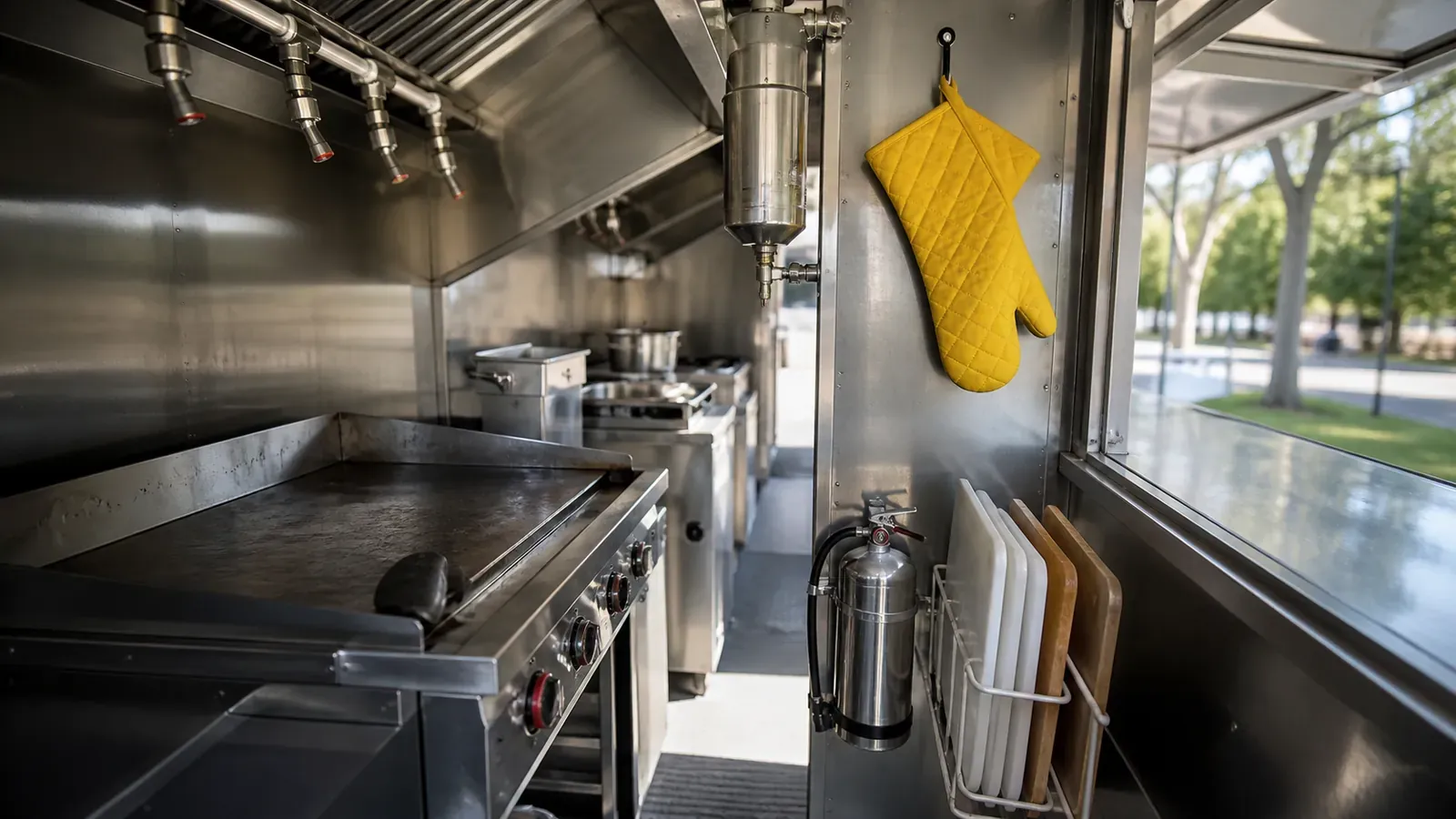
Fire suppression. The hood suppression system over your cooking line is the item both your fire authority and your underwriter will ask about. Two published standards recur in that conversation: NFPA 96, the standard for ventilation control and fire protection of commercial cooking operations, and UL 300, the test standard for extinguishing systems protecting commercial cooking equipment. This page does not publish which of them any jurisdiction has adopted or what your local fire marshal requires — adoption varies and it is a question for the authority where you operate, not for a national page.
Protective safeguards. Ask whether your quote carries a protective-safeguards condition — the ISO IL 04 15 family is the common form, used on property coverage. Where a condition like that applies, the named protective system is not merely encouraged: keeping it in working order is a condition of the coverage, and you are typically required to notify the carrier if it goes out of service. A suppression system that has lapsed out of certification is then not only an inspection problem.
Propane, generators, and grease. Propane raises questions about quantity, mounting, storage, and transport; generators about where they are mounted and whether they run during service; grease about duct-cleaning frequency and where used oil goes. Each of these can appear as an eligibility question, a rating factor, a warranty, or an exclusion depending on the carrier and the form — which is why "we have a fryer" is not enough information for anyone to price you accurately.
Ask these four in the quote: Does anything on this policy make a protective system a condition of coverage, and what exactly is named? What happens to coverage if the suppression system is out of service or out of certification? Is any cooking, propane, or grease exposure excluded, sublimited, or subject to a warranty on this form? What documentation of the suppression system, its inspections, and its certification do you want at bind and at renewal?
Status, Aug 5, 2026: the standards and the endorsement family named above are identified by title and form number — Verified as to their identity and purpose. Whether any of them applies to your policy or your jurisdiction is Blocked here and is carrier-, form-, and jurisdiction-specific. This page states no universal carrier requirement and no local fire-code adoption; confirm both with your underwriter and your fire authority.
What audit and subcontractors do to your premium
Evidence: the premium condition of the standard workers compensation and employers liability policy and general liability rating practice, plus each provider's stated rating basis. Verified with limitation as of August 5, 2026 — the applicable rating manual is NCCI's in most states and an independent state rating bureau's in others. Confirm the audit basis in your own policy before you bind.
Here is the part of the price that quote funnels do not put on the landing page. The premium on two of your policies is an estimate, and the estimate gets settled later. Workers compensation is rated on payroll. General liability is commonly rated on sales or payroll. At bind you give a projection; at the end of the policy period the carrier audits, compares your projection against what actually happened, and bills or refunds the difference. A strong season is a good problem that arrives as an invoice.
And the single biggest surprise in that invoice is other people's labor. When you pay a subcontractor or an event helper who cannot produce their own current coverage for the days they worked, that payment is commonly added to your payroll and rated at your classification. It does not matter that you called them 1099, that they invoiced you, or that they worked one Saturday. Two things happen at once: you have paid premium on labor you thought was somebody else's cost, and — if that person is hurt on your truck — you may be the one their claim lands on. Worker classification is a legal question decided on facts, not on paperwork, and it is not yours to settle alone.
This is also why the cheapest quote is frequently the wrong one. A quote built on an understated payroll or sales figure is not a saving; it is a deferred bill with your name on it.
What a class code is, and why yours decides the bill
Two numbers decide what your payroll costs you, and most operators never see either one until something goes wrong.
The class code is the rating classification the carrier assigns to describe what you actually do. It is not a description of your industry in general; it is the specific code, drawn from a rating manual, that sets the rate applied to each dollar of your payroll or sales. The manual is NCCI's in most states and an independent state rating bureau's in others, which is why the same operation can classify differently across a state line. One truck can pick up more than one classification, because cooking and serving at a window is not the same exposure as driving a converted vehicle down a highway — ask how payroll is divided between them, because that division is a rating decision with a price attached.
The code on your quote is the code the auditor tests. If the description of operations you gave at bind does not match what you actually did — you added catering, started towing, put someone behind the wheel who was not on the application — an auditor can reclassify. Reclassification changes the rate, not just the payroll figure, which is why it moves a bill further than most operators expect.
This page does not name a class code for food trucks, and you should be suspicious of any page that does. The right classification depends on your operations and on the manual in force in your state, and a code published nationally would be wrong often enough to cost you real money. Ask which one was assigned and why.
The experience modification is the second number. Once a workers compensation policy is large enough to meet the eligibility threshold that applies in your state, premium is adjusted by a factor comparing your own loss history to the losses expected for businesses in the same classification. Below that threshold there is no modification at all, and a new operation generally has no history to rate. It is worth knowing the term before a renewal conversation uses it at you.
Three questions for the quote: Which classification was assigned, and on what description of my operations? Is more than one classification applied, and how is payroll split between them? What happens to my premium if the auditor reclassifies part of the work?
Status, Aug 5, 2026: general rating practice — Verified with limitation. The applicable manual, the classifications available, and the experience-modification eligibility threshold are all state-specific and are Blocked here; confirm each with your producer or the rating bureau in your state.
What to collect from every sub and helper
Collect this before their first shift, not at audit. An auditor will accept a certificate you have; nothing will be accepted for a certificate you meant to get.
| What to collect | Why it matters at audit |
|---|---|
| A certificate showing their own general liability | Without it, their cost is commonly rated into your general liability exposure |
| A certificate showing their own workers compensation, if they have any workers | Without it, their payments are commonly charged to your payroll and rated at your class |
| Policy periods that cover every day they worked for you | A certificate that lapsed mid-season only protects the days it was in force |
| Your business named as certificate holder | So you receive notice and can prove what you held and when |
| An additional-insured endorsement, if your own contract requires you to pass one through | A certificate alone does not create it; see the COI workflow |
| A W-9 and a signed written agreement stating they carry their own coverage | Evidence of the arrangement, and the record an auditor will ask to see |
| A dated copy of all of the above, retained until your audit closes | The audit can run months after the season ends |
Before your audit, gather: payroll records by person and classification; every subcontractor certificate with its policy period; sales or revenue records on the basis your policy uses; a list of every driver and helper who worked the truck; and your original application, so you can see what you told the carrier and what changed. If a charge looks wrong, request the audit worksheet and the classification basis in writing, and route the dispute through your producer rather than the billing department. An audit is a factual reconciliation and it can be corrected with facts.
What food truck insurance costs, and what the number means
Every figure below was re-verified on its listed source page on August 5, 2026 and carries its own source period. No figure here is a quote, a market average, or a complete food-truck stack price. None of them is state-scoped — every source on this page publishes nationally, and your state moves all of them.
Before any number means anything, know what moves it. Food-truck pricing runs on three groups of inputs: the vehicle and who drives it (truck type and value, conversion cost, drivers and records, garaging ZIP, radius and mileage); the operation's exposure (menu and cooking methods, revenue, payroll, subcontractor use, event frequency, equipment and inventory values, claims history); and the structure of the policy itself (state, limits, deductibles, requested endorsements, and the payment plan's fees). Two trucks with the same paint job can price far apart on those inputs alone — which is why unlike figures must never be averaged into a "typical" cost.
Evidence types — what each figure can and cannot support:
| Evidence type | Can support | Cannot support |
|---|---|---|
| Live bindable quote | A real price for one defined profile at one moment | Anyone else's price |
| Indication | A non-binding ballpark for a stated profile | Final eligibility or final price |
| Provider-published starting price | The lowest advertised entry point for one product ("from") | What a typical buyer pays, or the cost of other coverages |
| Provider-published policy limits | What one named product actually carries, before endorsements | That your quote will carry the same limits |
| Provider median with published distribution | Where that provider's own buyers of that coverage actually landed, over a stated period | The market, your state, or your full stack |
| Provider median / average benchmark | That provider's own book, on its stated basis | The food-truck market, or your full stack |
| CMT premium sample | A dated, fully profiled illustration — once published | A guaranteed quote or a market benchmark |
Current dated evidence:
| Source | Published figure | Evidence type | What it covers | Source period and profile | Not included / missing | Status |
|---|---|---|---|---|---|---|
| FLIP | From $299/year paid annually, or from $25.92/month on the monthly plan | Provider-published starting price | Base food-truck policy: general liability plus product liability | Page as of Aug 5, 2026 | Commercial auto is not offered by FLIP; tools and equipment, liquor, cyber, workers comp, and the trailer endorsement are separate; state and operation eligibility not stated. The two published prices do not reconcile: twelve monthly payments total about $311, roughly $12 above the annual price. Confirm whether that gap is an installment or finance charge before comparing it to anything | Verified as published; the annual-to-monthly difference is undisclosed on the source — Verified with limitation |
| FLIP | $1M each occurrence · $2M general aggregate · $2M products–completed operations · $1M personal and advertising injury · $300,000 damage to premises rented · no liability deductible · inland marine $5,000 any one article / $10,000 aggregate with a $250 deductible · $5,000 medical expense | Provider-published policy limits | The base FLIP food-truck policy as advertised | Page as of Aug 5, 2026 | Not a quote; endorsements, the actual policy, and eligibility control | Verified |
| FLIP | Average general liability claim by its food-truck policyholders: $6,271, most commonly a customer slip-and-fall | Provider-published book statistic | FLIP's own food-truck policyholders | Page as of Aug 5, 2026 | No claim-sample date range or size stated on the page; not a market figure and not a prediction for you | Verified with limitation |
| Simply Business | General liability median $29/month (about $350/year); 0% of its food-truck GL buyers paid under $25, 92.5% paid $25–$95, 7.5% paid over $95 | Provider median with published distribution | General liability only | Its customers classified as a food-truck business who bought a GL policy, July 1–December 31, 2024; page as of Aug 5, 2026 | Commercial auto is not offered on its food-truck pages; its own disclaimer states pre-quote prices are estimates that vary by state, provider, and business | Verified — supersedes the 10th-percentile figure previously published here, which no longer appears on the source |
| Simply Business | Workers compensation median $120/month ($1,438/year as published — the two figures are the source's own and are not an exact multiple); 83% paid under $150, 17% paid $150–$250, 0% paid over $250 | Provider median with published distribution | Workers compensation only | Same customer set and July–December 2024 window; page as of Aug 5, 2026 | Not available privately in North Dakota, Ohio, or Washington, and classification-dependent in Wyoming; payroll, classification, and claims history drive it; reconciled at audit | Verified |
| Progressive Commercial | $207/month median; $276/month average per power unit | Provider median / average benchmark | Business-auto liability and physical damage, new customers with clean driving records | 2025 new policy premium per power unit, for-hire truck and tow truck excluded; page as of Aug 5, 2026 | Business Auto category, not food-truck-specific; no liability, property, or food-product stack | Verified |
| Cover My Trade sample | Not yet published | CMT premium sample | — | — | Blocked: the required profile fields (state and ZIP, operations, vehicle and equipment values, payroll, revenue, limits, deductibles, fees, carrier, and quote status) have not been captured from a live quote or labeled indication | Blocked |
A worked planning model, leg by leg
Three legs, three published sources, three different bases. Read them separately. Do not add them together — that is the arithmetic on unlike objects this page exists to argue against, and two of the three sources exclude the vehicle entirely.
| Leg | Low anchor | Base anchor | High anchor | The driver moving the spread |
|---|---|---|---|---|
| Liability (general plus product) | $25.92/month — FLIP's published monthly entry price at its base gross-sales tier, with the limits listed above ($299/year paid annually) | $29/month — Simply Business's published median for its food-truck general liability buyers | Over $95/month — where 7.5% of those buyers landed | Gross annual sales. FLIP states its general liability premium is related to gross annual income and publishes a sales-tiered schedule; Simply Business names work type, location, team size, and limits. A truck doing $250,000 does not price where a weekend truck prices. |
| Workers compensation (only if you have workers) | Under $150/month — where 83% of Simply Business's food-truck workers-comp buyers landed | $120/month — its published median | $150–$250/month — where the remaining 17% landed | Payroll and classification, and this leg is the one reconciled at audit. Not purchasable privately in North Dakota, Ohio, or Washington; in Wyoming it depends on your NAICS classification. |
| Vehicle (per truck) | $207/month — Progressive's Business Auto median per power unit | Between the two — most buyers sit nearer the median | $276/month — the Business Auto average per power unit | Outliers. Progressive's own commercial auto cost page states that many customers pay nearer the median because expensive outliers pull the average up. Your vehicle value, conversion, drivers, radius, and record decide which side you sit on. |
Read that table with its labels, not around them. The liability and workers-compensation rows come from two providers over two periods; the vehicle row is a benchmark from a broad business-auto book that is not food-truck-specific. Adding a liability starting price to an auto benchmark and calling the sum an "average food truck premium" is arithmetic on unlike objects; no figure above should be repeated anywhere as a market average or a complete-stack quote.
What the model does tell you is where the money goes. Across all three legs one input recurs: how much the truck actually works. Sales drive the liability leg, payroll drives the workers-compensation leg, and miles, drivers, and radius drive the vehicle leg. A truck that doubles its event calendar prices higher on all three — and only one of the three will tell you so before the policy year ends. That is the audit.
A Cover My Trade premium sample for a defined food-truck profile will appear here only when every field our premium data standard requires — profile, coverages, limits, deductibles, fees, carrier, and quote status — is captured and dated. Until then the fastest useful step on cost is not another benchmark: it is preparing your own quote inputs with the checklist below.
Compare buying paths by stack fit, not headline price
All fields verified against each provider's own current page on August 5, 2026; recheck required on publication day. Cover My Trade has no confirmed commercial relationship with any option below; inclusion and order follow reader fit and evidence. This is an equal-field comparison, not a ranking — no "best" or "cheapest" is declared.
Who actually issues the policy: provider roles explained
Who issues and bears your policy, who picks up the phone for a COI, and where your application data travels all depend on the provider's market role — and the role is rarely obvious from a landing page. On this page a provider's role is stated only where that provider's own current documentation supports it, and labeled Role not verified otherwise.
| Role | Who issues and bears the policy | What the role changes for the buyer |
|---|---|---|
| Direct carrier | The company itself underwrites, issues, and bears the risk | One product set and appetite; pricing, COIs, and claims are handled in-house |
| MGA / program administrator | Administers a specialty program on behalf of one or more issuing carriers, which bear the risk | Specialty fit and workflow; confirm the issuing carrier, the forms, and who services COIs and claims |
| Broker / agency | A licensed producer places coverage; a carrier issues and bears the policy | One application can reach multiple carriers; the producer is usually your quoting and COI contact |
| Comparison marketplace | The marketplace issues nothing; it routes you to carriers or producers, and may itself be a licensed producer | Compare several options at once; confirm which entity actually issues and services the policy, and how your data and leads are routed |
Two more fields decide more than most buyers realize. Admitted or surplus lines: an admitted carrier's forms and rates are filed with your state and its policyholders generally have state guaranty-fund protection if the carrier fails; a surplus-lines placement usually has neither. Financial strength: a rating from an agency such as AM Best is an opinion on a named issuing carrier's ability to pay claims — which means you have to know which entity actually issues your policy before the rating means anything.
Current buying paths on equal fields
Fit, role, and products.
| Option | Role | Best fit to quote for | Not ideal for | Food-truck products on its page | Commercial auto |
|---|---|---|---|---|---|
| FLIP | Food-specialty program; issuing carrier and exact role — verify at quote | A food-specific liability base with published limits and a published entry price, where events keep asking for certificates | Anyone who needs the vehicle covered — its own cost page states it does not offer commercial auto, so you will run a second market for the truck regardless | Base liability package with published limits; optional inland marine, liquor, cyber, workers comp, professional liability, trailer endorsement | Not offered — see the source conflict noted below |
| Simply Business | Marketplace and licensed producer, per its own footer | Comparing several carriers on liability and workers comp from one application, with published medians you can sanity-check a quote against | The vehicle, which its food-truck pages do not offer — and anyone who needs to know the issuing carrier before applying, since you learn that at quote | Food-truck general liability and workers compensation, with a multiple-quote workflow | Not offered on its food-truck pages — separate market required |
| Insureon | Marketplace / agency, per its page | A one-stop menu across BOP, workers comp, liability, auto, liquor, and cyber through an agency workflow | Price-first shoppers — no current food-truck price is published, so expect quote-first and expect to ask which carrier is behind it | BOP, workers comp, general liability, commercial auto, liquor, and cyber listed for food trucks; one-application comparison | Listed on the menu; eligibility is quote-specific |
| Progressive Commercial | Direct carrier — auto-first route, per its page | An operation where the vehicle leads: high-value conversion, multiple drivers, or a wide radius, with non-auto lines on the same route | Buyers who want a published food-truck liability price before applying — and operators in the District of Columbia, where its own page states it does not currently write | Dedicated food-truck page; commercial auto plus general liability, BOP, workers comp, and cyber through the same route | Core offering |
Evidence, market, and workflow.
| Option | Market and states | Price evidence on its page | Financial strength | COI and endorsement workflow | Verify before relying on it | Status |
|---|---|---|---|---|---|---|
| FLIP | Admitted or surplus not stated on the cited pages; state footprint not stated — verify both | From $299/year, or $25.92/month on the monthly plan, base package only; sales-tiered schedule published | Not published on the cited pages — verify at the AM Best listing once the issuing carrier is identified | Certificate access after purchase; states additional insureds can be added free and without limit from the customer dashboard | Issuing carrier; state and operation eligibility; forms and exclusions; attached-equipment and spoilage treatment; fees; which endorsement wording it will issue | Verified with limitation |
| Simply Business | Depends on the carrier it routes you to — ask which; licensed as a producer in all 50 states and the District of Columbia, per its own footer | GL median $29/month and workers comp median $120/month, each with a published distribution, July–December 2024 | Attaches to whichever panel carrier issues — ask which, then check that carrier's rating | Quote-path dependent; states it sends the certificate and policy documents after purchase | Which carrier returns your quote; final price and down payment; state availability for your operation; the vehicle path | Verified with limitation |
| Insureon | Depends on the issuing carrier — ask which; state footprint not established on the cited page | No current food-truck price published on the cited page | Attaches to the issuing carrier — ask which | Certificate download after policy payment, per its page | Exact carrier and forms; limits and fees; eligibility; endorsement workflow | Verified with limitation |
| Progressive Commercial | Admitted or surplus not stated on the cited pages; insures commercial vehicles in all 50 states and states it does not currently write in the District of Columbia | $207/month median, $276/month average per power unit — 2025 Business Auto benchmark, not food-truck-specific | Not published on the cited pages — verify at the AM Best listing | Not stated on the cited pages — verify | Eligibility for your truck type, state, and conversion; equipment scheduling; whether the non-auto lines fit your operation | Verified with limitation |
What each option's own documentation establishes, and what it leaves open
The tables above carry the comparable fields. These four notes carry something the tables cannot: how far each provider's own published documentation actually gets you before a human has to answer the rest.
FLIP
Its documentation is unusually complete at the front end and stops abruptly at the back end. The limit schedule and the sales-tiered entry price are published, which is rare — you can see what the base package carries before you speak to anyone. What its pages do not establish is who underwrites it, which states and operations are eligible, or what the actual form excludes, and its own cost page removes the vehicle from the conversation entirely. Treat it as a well-documented liability base whose issuing entity is an open question. Confirm in the quote: Which carrier issues the policy, and is it admitted in my state? What does the form say about food claims and about attached versus loose equipment? Is spoilage included, sublimited, or absent? What does an additional-insured endorsement with custom wording cost and how long does it take?
Simply Business
Its documentation establishes the workflow and the price distribution, not the product. The published medians with their percentage bands are the most transparent price evidence on this page, and its footer establishes its own licensure. What it cannot establish in advance is the thing you are actually buying: the issuing carrier, its form, and its appetite for your operation are all revealed at quote, not before. That is a reasonable trade for comparison breadth — as long as you know you are comparing routes rather than policies. Confirm in the quote: Which carrier came back, and is it admitted? What is the down payment and what does the payment plan cost? Is my operation eligible in every state I work? Where do I go for the vehicle?
Insureon
Its documentation establishes the breadth of the menu and almost nothing about price. Every line a food truck might need appears on one page, including commercial auto, which makes it the only option here that does not force you into a second market by design. The cost is opacity at the front: with no published price, you cannot sanity-check anything until you have applied. Confirm in the quote: Which carrier is behind each line, and are they the same carrier? What limits and fees apply? Is my operation eligible for the auto line specifically, or only for the liability lines? What is the certificate turnaround after payment?
Progressive Commercial
Its documentation is the strongest on the vehicle and the weakest on the food operation. Its exclusion list — the one naming unattached business equipment — is the single most useful published statement on this page for a converted truck, and its benchmark figures come with their basis and exclusions stated. It also states plainly where it does not write. What it does not publish is a food-truck liability price, a financial-strength reference, or its certificate workflow. Confirm in the quote: Is my truck eligible at its weight, class, and conversion value? What valuation basis applies to the conversion, and exactly what is scheduled? Are the non-auto lines written by Progressive or routed elsewhere, and to whom? What is the COI and endorsement workflow, and what does an endorsement cost?
A source conflict worth knowing about. FLIP's site navigation lists a commercial auto coverage page, while its food-truck cost page states plainly that FLIP does not offer commercial auto at this time. Both were live on August 5, 2026. This page treats the food-truck-specific page as controlling, because it is the more specific source, and records the conflict rather than resolving it silently. Ask FLIP directly before you assume either answer.
Two ground rules govern this table: any option that cannot pass the publication-day evidence gate — its own current page still supporting every displayed field — is removed rather than padded with weaker sourcing, and no option's order or presence reflects any prospective commission. Considered but not cleared: NEXT, Hiscox, Thimble, Tivly, and specialty restaurant programs were reviewed as candidates but are not included, because a current first-party food-truck or food-vendor page confirming these exact comparison fields was not verified as of August 5, 2026. That is the failed inclusion gate, and it is the only reason stated.
When the answer is no
Not every operation gets a clean quote, and the readers who most need a route are the ones the corpus ignores. Take the branch that matches you.
- No admitted carrier will write you. Deep fryers, propane, a high-value conversion, liquor service, wide festival travel, and a short operating history all narrow appetite. The placement may go to a surplus-lines market through a broker, which usually means non-filed form language and, in most states, no guaranty-fund backstop if the carrier fails. That can be the right answer — make the broker state it in writing, and ask your state department of insurance how surplus lines are treated where you operate.
- The required limits cost more than you can carry. An umbrella over a lower primary is often cheaper than raising the primary — but confirm the contract accepts an umbrella first, because some venue wording requires the limit on the primary policy. If it still does not work, renegotiate the contract; do not misdescribe the operation to make the quote fit.
- Your loss history is against you. Expect higher deductibles, scheduled exclusions, or a surplus-lines placement before an outright decline. Ask the underwriter what specifically would change the answer at renewal, and get it in writing.
- You are operating uninsured right now. Say it plainly to a licensed producer today rather than at the next event. Going bare exposes you personally to judgments, and in states that require workers' compensation it can carry penalties and stop-work exposure — your state's authority publishes what applies. And understand the hard part: no policy you buy today responds to a loss that already happened. If something has already gone wrong, report it to the carrier that was on risk at the time, or tell a licensed producer and, where the facts warrant it, a lawyer. There is no version of this where changing dates or descriptions helps you.
- You were non-renewed mid-season. Notice periods and cancellation rules are set by state law and vary. Contact your state department of insurance for the notice rule that applies to you, start replacement quoting the day the notice arrives rather than the week the policy ends, and tell the new market why — a non-renewal you disclose is an underwriting question, and one you conceal is a rescission question.
Deadlines, what they cost you, and whether you can fix them
Three clocks run on a food truck, and they fail differently. This page does not publish any state's notice period or any carrier's audit window — both are set elsewhere and both vary — but the shape of each failure is the same everywhere.
| Deadline | What it costs you if you miss it | Can you cure it? |
|---|---|---|
| The event or contract certificate deadline | The booking. A venue is under no obligation to accept proof that arrives late or in wording it did not ask for, and an endorsement request discovered on the deadline usually cannot be processed in time | Only before the event, and only after valid coverage binds. There is no version that starts with the certificate |
| A cancellation or non-renewal notice | The runway to replace the policy. The damage is rarely the notice itself — it is discovering it late and quoting under pressure, or letting coverage lapse and creating a gap you then have to disclose to every future market | Yes, if you act from the notice date rather than the expiry date. Ask your state department of insurance which notice rule applies to you; the period is state law and this page does not publish it |
| The premium audit response window | Control of your own numbers. Where an insured does not produce records, carriers commonly estimate the audit and bill on that estimate, and the burden then sits with you to reverse it | Usually yes, with facts. Produce the records, request the worksheet and the classification basis in writing, and route the dispute through your producer — see what audit and subcontractors do to your premium |
How to handle an event COI or additional-insured request
Workflow evidence: Insureon, FLIP, and Simply Business pages as of August 5, 2026, applicable to those providers only. No site-wide timing promise exists or is implied.
Event urgency is real, but the legitimate sequence is short and always the same:
- Collect the written requirement — the requester's legal name and address, required policy types and limits, event location and dates, certificate-holder details, the deadline, and the exact additional-insured, waiver-of-subrogation, primary/noncontributory, or cancellation-notice wording requested.
- Separate the two asks. A certificate holder is who receives the proof document. An additional insured is a change to the policy itself, made by endorsement. A certificate alone does not add or broaden coverage — ever.
- Bind valid coverage first. There is no compliant path to proof before a policy exists.
- Have the carrier or authorized producer issue the certificate and process endorsements. Provider workflows differ: Insureon's current page places policy payment before certificate download, FLIP describes certificate access after purchase and states that additional insureds can be added free and without limit from its dashboard, and Simply Business states it sends the certificate after purchase — evidence for those paths only, not a universal timeline. Custom endorsement wording can take additional handling beyond ordinary certificate access.
- Confirm acceptance with the requester before the deadline. Nothing obligates a venue to accept wording it did not ask for.
The contract words, decoded
You will meet these in a venue agreement, and you cannot negotiate what you cannot read.
| Term | What it actually means |
|---|---|
| Certificate holder | The party who receives the proof document. Being one changes nothing about coverage. |
| Additional insured | A party added to your policy by endorsement so your policy responds for them too. Ask whether the request is for ongoing operations (the ISO CG 20 10 family), completed operations (the CG 20 37 family), or both — they are different endorsements and a contract may need both. |
| Waiver of subrogation | Your carrier gives up its right to recover from that party after paying a claim. Added by endorsement (the ISO CG 24 04 family); it is not automatic and it can carry a charge. |
| Primary and non-contributory | Your policy pays first and does not ask theirs to contribute. A separate endorsement request, not a synonym for additional insured. |
| Per occurrence vs. aggregate | The most the policy pays for one claim, versus the most it pays across the whole policy period. A $1M/$2M structure can be exhausted by a bad season. |
| Sublimit | A smaller cap sitting inside a bigger limit — common on spoilage and on any-one-article equipment cover. |
| Waiting period | Time that must pass before a coverage responds at all. Common on spoilage and business interruption. |
| Indemnity clause | Your promise to cover the other party's losses. It can be written far broader than any insurance you carry, and the gap is yours personally. This is the clause to take to a lawyer, not an agent. |
Escalate to a licensed professional when the request involves unusual or government-form wording, multiple venues on one certificate, liquor service, or indemnity language that conflicts with your policy. For definitions and the general process, the owning explainer is how a certificate of insurance works. When you request proof, lead with the written requirement — not with same-day expectations.
Prepare the quote accurately and know when to stop
A quote is only as good as its inputs. Collect these five blocks once and reuse them on every path — the same fields, in the same order:
| Block | Collect |
|---|---|
| Vehicle | VIN, year, make, model, weight; title or lease; value and conversion cost; attached equipment; garaging ZIP; radius and mileage; use; every driver and record; requested physical damage |
| Operations | Legal entity and DBA; menu and cooking methods; suppression system and its certification status; catering, wholesale, or alcohol activity; commissary; states, cities, and events; hours; revenue; prior operations and losses |
| People | Owner status and any owner inclusion or exclusion election; employees, part-time and seasonal workers, volunteers; subcontractors; payroll, headcount, and subcontractor cost — with the state rule checked through the state router above |
| Property | Generators, refrigeration, POS, tents, tools; inventory values; storage locations, including anything kept at home; deductibles; the spoilage and business-interruption questions you need answered |
| Requirement | The requester; event, location, and date; certificate holder; required limits; exact endorsement wording; deadline |
Understating anything — driving, food operations, equipment values, worker use, event frequency, alcohol, prior losses — does not lower your real cost. It undermines eligibility, it makes the quote useless as a decision tool, and on the audited lines it comes back as a bill. Submit these details only through a provider's own secure application, never an unverified form, and do not hand over contracts, tax IDs, or driver records to any workflow you have not checked.
Stop and get licensed or legal guidance when you hit: an unclear vehicle classification, converted-equipment valuation, employee-versus-subcontractor status, liquor obligations, contract indemnity or endorsement wording, a declined or restricted quote, an audit bill you believe is wrong, or any claim-specific coverage interpretation. Worker-status questions in particular deserve care beyond insurance — the broader hiring steps live in the first-employee checklist.
Choosing a provider at a glance
Every path below is an option to quote — eligibility and pricing remain underwriting-dependent. Each option's best-fit and not-ideal-for lines live in the comparison above so the fit judgment is stated once, beside the evidence that supports it. This table maps situations to moves.
| Situation | State-dependent factors | Shortlist move | Documents to collect | Confirm in the quote |
|---|---|---|---|---|
| Solo owner, one owned truck, public locations, no employees | Auto minimum limits; health and vending permits in every jurisdiction you park in | Quote commercial auto for the truck, plus a food-specialty or marketplace liability quote | Title, VIN, conversion invoices, driver record, menu, equipment inventory with values, gross sales | Is conversion and attached equipment scheduled, and on what valuation basis? Is products/completed operations in the form? COI turnaround after binding? Fees and deposit? |
| Trailer or cart only, towed by a personal vehicle | Whether your state treats the tow vehicle's use as commercial | Analyze the trailer and the tow vehicle; ask whether a trailer endorsement is needed | Trailer VIN and value, the tow vehicle's current policy declarations, commissary agreement | Is the tow vehicle's business use covered, in writing from that carrier? Is the trailer separately scheduled? |
| Crew with payroll, festivals in more than one state | Workers-comp threshold and owner election vary; North Dakota, Ohio, and Washington are state-fund only, Wyoming's fund requirement is classification-based, and all four generally exclude employer's liability | Confirm each state's rule through its authority first, then marketplace quotes including workers comp | Payroll register, headcount by state, driver list and records, every event contract | Which states is the policy filed in? What is the audit basis and when does it run? Do I need stop-gap employer's liability? Additional-insured availability and cost? Hired and non-owned auto? |
| Regular 1099 event help | Worker classification is fact-specific and state-governed | Collect certificates before the first shift; get classification advice before you hire again | Each helper's own GL and workers-comp certificates covering the exact dates worked, W-9, signed agreement | How is uninsured subcontractor cost treated at my audit? What records will the auditor want? |
| Serving or selling alcohol | Local alcohol licensing layered on state rules; carrier appetite narrows sharply | Confirm the license first, then quote liquor liability as its own line | Alcohol license, event contracts with their exact insurance wording, service hours and volume | Is liquor liability on the quote or excluded? What limits does the venue's wording require? Is the liability leg rated on liquor sales? |
| An audit bill has arrived | Rating rules are NCCI's in most states and an independent bureau's in others | Request the worksheet before you pay; route the dispute through your producer | The audit worksheet, sub certificates you collected, payroll records, your original application | What classification was applied and why? Which payments were treated as payroll? What evidence reverses a charge? |
| Pre-launch — the truck is not built or bought yet | Which jurisdictions you intend to serve, and their permit rules, before you commit to a route | Get an insurability read on the intended build before you commit to the conversion, not after | Build quote and conversion invoices as they are incurred; intended menu, cooking equipment, and suppression system; intended radius | Is this build eligible, and at what value? What suppression documentation will you want at bind? Does the intended menu change the appetite? |
| Non-renewed mid-season | Notice periods and cancellation rules are state law and vary | Start replacement quoting the day the notice arrives; disclose the non-renewal to every market you approach | The non-renewal notice with its date, loss runs, your original application | What in my file drove the non-renewal, and what would change it? Is a surplus-lines placement the realistic route? |
| A surplus-lines placement is the only route | Surplus-lines treatment and the guaranty-fund position vary by state | Have the broker state the market in writing, then read the form rather than assuming the standard wording | The broker's written statement of market and form, the actual policy wording, your loss runs | Which market and which form? Is there any guaranty-fund protection in my state? Which standard-form provisions are missing or amended? |
| Commissary-based, with a landlord or commissary insurance clause | Lease and commissary rules are local; the agreement itself is a contract, not law | Pull the clause and quote to it before you sign, not after the first inspection | The lease or commissary agreement, its insurance clause verbatim, required limits and endorsement wording | Does the quote meet the clause's limits and endorsements? Is stored equipment covered at that location? Is a loss payee or additional insured required? |
One scorecard, every path: score each provider against the same quote-preparation checklist above — identical fields, identical order — rather than a different question set per provider. Symmetry is what makes the comparison honest.
Frequently asked questions
Is general liability enough for a food truck?
No single policy is. General and product liability address customer injury, third-party property damage, and food-related allegations per the form — they do not address the truck, its attached equipment, workers, or contract endorsements, and they do not pay to redo your own work or replace your own product. Work the matrix above row by row instead of buying one label.
Can a food truck use personal auto insurance?
Do not assume so. The standard personal auto policy carries exclusions for public or livery conveyance and for vehicles used in a business, and Progressive's own commercial page states that most personal car insurance does not cover business activities. The exclusion is not identical for every vehicle type — the standard form carries an exception for private passenger autos and for pickups and vans owned by the insured — which is why a converted box truck and a personal pickup towing a trailer are two different questions. Ask your personal carrier in writing, name the food operation and the trailer in the question, and keep the answer.
Does food truck insurance cover the generator and spoiled food?
They are two separate questions. A loose generator is portable equipment — an inland marine or tools module, not auto physical damage, and Progressive's own page lists unattached business equipment among what commercial auto does not cover. Spoiled inventory depends on optional spoilage coverage, its covered causes, sublimit, deductible, and waiting period. Check the per-article limit as well as the aggregate on the equipment side, and verify both in the actual form wording.
Does this page tell me my state's workers' comp rule?
No, and it should not pretend to. Thresholds, owner-election rules, and penalties are state law and change. What this page gives you is the router to all fifty states and the District of Columbia, the four states with an exclusive fund — including how Wyoming's classification-based rule differs from the other three — the employer's liability gap those funds leave open, and a worked example of what a complete state answer contains. Take the threshold question to the linked authority or to workers-comp requirements by state.
How fast can I get a festival COI?
Commonly same-day to a few business days after a policy binds — and the clock is set by the slowest dependency: complete quote inputs, underwriting review, payment or deposit, endorsement processing for additional-insured, waiver-of-subrogation, or primary/noncontributory requests, and the certificate-holder details from the requesting party. A COI is evidence of a bound policy, never a substitute for one; there is no legitimate proof before coverage exists.
Why did I get a bill after my policy year ended?
Because workers compensation and general liability are usually rated on payroll or sales that you estimated at bind, and the carrier audits the actuals at the end of the period. The most common driver of a surprise charge is subcontractors and event helpers who could not produce their own coverage for the days they worked — their payments are commonly added to your payroll and rated at your classification. A reclassification changes the rate as well as the payroll figure, which is why an audit bill can land further from the quote than the extra sales alone would explain. Ask for the audit worksheet and the classification basis in writing, and route the dispute through your producer. The audit section above lists what to collect and when.
How much does food truck insurance cost per month?
No Cover My Trade premium sample is published yet for a defined food-truck profile — that slot stays open pending our full data-standard field set. What this page publishes instead are three separately labeled legs, all verified August 5, 2026: liability from FLIP's entry price of $299/year, or $25.92/month on its monthly plan, against a $29/month median for Simply Business's food-truck general liability buyers (July–December 2024); workers compensation at a $120/month median for that same customer set; and the vehicle at Progressive's $207/month median and $276/month average per power unit for Business Auto in 2025. None is state-scoped and none should be added to the others. The leg-by-leg model and its full assumptions are in the cost section above.
Your next step
Work the sequence, in order. List the truck, drivers, conversion and equipment values, menu, cooking equipment and its suppression system, workers, locations, revenue and payroll, claims, and every written event or contract requirement. Find your state's workers-compensation authority in the router above and check the vehicle, permit, alcohol, and contract sources that apply to every jurisdiction you serve. Collect a certificate from every sub and helper before their first shift and keep it until your audit closes. Compare current quote paths on the same checklist fields — including whether commercial auto and the non-auto stack must be bought separately, which for two of the four options on this page they must — and ask the carrier or licensed producer to confirm eligibility, exclusions, scheduled values, spoilage treatment, the classification assigned to your operation, endorsements, the audit basis, fees, and the proof workflow in writing. Then bind legitimate coverage, and only after it binds, request the certificate your contract asks for.
Sources and last verified date
Last verified: August 5, 2026
Next review: September 5, 2026
- Food truck insurance — Progressive Commercial — commercial-auto coverage scope for food trucks and what auto policies exclude.
- Commercial auto insurance — Progressive Commercial — 2025 per-power-unit median and average premium figures cited in the cost section.
- Monopolistic states — Progressive Commercial — the four exclusive-fund states and the employer's liability gap.
- Food truck insurance cost — FLIP — entry-price liability evidence ($299/year plan).
- Food truck insurance cost — Simply Business — general-liability and workers-comp medians for food-truck buyers.
- Food truck insurance — Insureon — marketplace coverage and pricing context.
- License and permit FAQs — Texas Alcoholic Beverage Commission — alcohol-service permitting in the Texas worked example.
- Employer information — California DWC — California's one-employee workers-comp rule.
- Division of Workers' Compensation — Texas Department of Insurance — Texas's elective workers-comp structure.
- Do I need a workers' comp account? — Washington L&I — exclusive-fund state registration rule.
- Workers' compensation for employers — Florida DFS — Florida threshold routing in the jurisdiction router.
- Workers' compensation overview — Kansas Department of Labor — the payroll-threshold structure noted in the router.
Tivly
Matches your trade to a specialist agent by phone — the right path for harder-to-place trades and anyone who'd rather talk it through.
Get matched to an agentSimply Business
A broker that compares multiple carriers on one form — useful for trades that get declined or overpriced by a single insurer.
Compare carriersHiscox
A specialist in professional and consulting liability with strong coverage for advice-based work — the pick when E&O matters more than premises risk.
Compare Hiscox coverageNEXT Insurance
Built for small business: general liability, workers comp, and pro liability quoted and bound online in about 10 minutes — and your COI is instant and free after.
Get an instant quote