
Hair Stylist Insurance: Costs & Coverage
Advertiser disclosure: Cover My Trade may earn a commission when you request a quote or buy a policy through links on this site. It never changes your premium, and it never changes our editorial read — coverage requirements depend on your state, your contracts, and your payroll, and we say so on every page.
Provider and price details on this page were verified as of July 20, 2026. State workers' compensation rules and endorsement-form references were verified as of August 6, 2026 — the requirement rule is verified against the governing authority for 18 jurisdictions, and every other state and the District of Columbia is listed below with its own agency and routed there. Where a row's evidence period differs, the date appears beside the row. Cover My Trade is an independent editorial publisher — not an insurer, agency, broker, or advisor, and it holds no insurance producer license in any state.
Need proof of insurance by a deadline?
Bind a valid policy first. A certificate can only follow one — it cannot be issued ahead of coverage, and no legitimate party will produce one without a policy behind it. Three things not to get wrong while you move fast:
- Every service you perform must appear on the policy's covered-service list before you pay. A service that is absent or ambiguous is a quote question to settle in writing, not a gap to discover in a claim.
- An additional-insured request needs an endorsement, not a name typed on a certificate — and endorsements routinely take longer to process than certificates do.
- Get the requester's exact legal name, mailing address, required policy types and limits, and any exact endorsement wording before you quote, so the proof you buy matches the proof you owe.
The full sequence, including who issues what and in what order, is in Where you work, what you own, and who needs a COI.
Which insurance path is yours?
"Hair stylist insurance" is a stack of separate protections, not one standardized policy — and the right stack depends on how you operate before it depends on any price. A booth renter, salon employee, suite tenant, mobile stylist, and salon owner face different contracts, insurance responsibilities, and worker questions, and a salon's policy may not insure a renter's own business or services. General liability addresses third-party bodily injury and property-damage questions around your premises or operations; professional liability, or another service-error mechanism, addresses different allegations that a cut, color formula, chemical process, hot tool, extension, or consultation caused harm. Products, portable tools, fixed property, workers' compensation, cyber, and vehicle exposures may each need separate treatment.
Route by how you operate:
- If you rent a booth or suite, work mobile, or work from home — quote an individual stylist policy: general liability plus professional liability together, priced as one decision.
- If you own or lease the salon and rent stations or employ staff — quote a salon-owner path. The insured entity, the premises, and the worker questions all differ from a one-person policy.
- If you are a W-2 employee with no side business — verify before you buy. Ask what your employer's policy actually covers, in writing, before purchasing anything.
- If you have or plan to add employees or assistants, or your salon or suite contract's insurance clause is unwritten or unclear — confirm the requirement first. Workers' compensation obligations are set by your state, and the written contract controls what proof you owe. Start at Do you need workers' compensation? Your state decides.
Every path here is an option to quote, never a promise of coverage or eligibility. Pricing and acceptance are underwriting decisions made by the carrier, not by this page. And on price: there is no single answer to what this costs, and any page that gives you one is describing somebody else. Your number is set by your state, operating model, services and chemicals, revenue, workers, limits and claims history — the drivers, dated provider figures and a worked example of which changes move the number most are further down this page.
Who this page covers. It is written for licensed hair stylists, colorists, and barbers working as employees, booth or chair renters, suite tenants, salon owners, mobile stylists, or home-studio operators. Nail technicians, estheticians, lash and brow technicians, massage therapists, and permanent-makeup or microblading artists face different covered-service lists, different program eligibility, and in most states a different license — where those services are part of your book, treat every statement here as a starting point and confirm your own modalities against the policy form and your state board. Nothing on this page covers medical or cosmetic-medical procedures.
On this page
- Need proof of insurance by a deadline?
- Which insurance path is yours?
- What hair stylist insurance do you actually need?
- Hair stylist coverage and requirement matrix
- Start with the operating model: booth renter, employee, salon owner or mobile stylist
- Separate client accidents from service, chemical and product risk
- Where you work, what you own, and who needs a COI
- Do you need workers' compensation? Your state decides
- Is a license or a bond the same as insurance? And what a quote needs
- What hair stylist insurance costs, and what the number means
- Compare buying paths by fit and evidence, not headline price
- Choosing a provider at a glance
- How this page is built, sourced and reviewed
- Frequently asked questions
- Your next step
What hair stylist insurance do you actually need?
The answer runs through six gates, in order — each a fact-or-document question, not a shopping question. Salon-owner insurance, an individual stylist policy, a landlord's policy, and a salon's general policy solve different problems; the gates tell you which problem is yours before any provider tells you a price.
The six-gate booth-renter triage
| Gate | What to establish before quoting |
|---|---|
| 1. Your actual role and relationship | Employee, booth or chair renter, suite tenant, salon owner, mobile stylist, home-based operator — or a combination. Labels like "1099" or "independent" do not decide this by themselves. |
| 2. The written agreement | What the salon, suite, landlord, venue, or client contract actually requires: policy types, limits, certificate holder, endorsement wording, dates. |
| 3. Services and chemicals | Cuts only — or color, bleach, smoothing or keratin, extensions, hot tools, barbering, treatments, add-ons? Each service must appear on the policy's current covered list. |
| 4. Locations, tools, and products | Where you work; what portable and fixed property you own and its value; whether you sell retail or private-label product as well as use product in services. |
| 5. Workers, data, and vehicles | Assistants, substitutes, renters, and payroll; your state's workers' compensation rule for that arrangement; booking and payment data; any vehicle used for work. |
| 6. Policy, COI, endorsement, and underwriting | What must be validly bound, what proof is requested, which endorsements the contract names, and whether a carrier will actually accept your operations. |
Your first action: before requesting a single quote, collect the signed agreement and build a current operations inventory — services and chemicals, product use and sales, locations, tools and values, workers and payroll, revenue, claims history, the limits asked of you, and your deadline. Those inputs make quotes comparable and certificates accurate. If your operations extend beyond hair services, start from what insurance your business may need and come back for the stylist-specific gates.
The one thing to get right before anything else: a certificate of insurance follows a valid, bound policy — it does not create coverage, add an insured, or change limits by itself. A cosmetology license, an LLC, a client waiver, or the salon's own policy is not proof that you are insured. If a contract asks for an additional-insured listing, that normally requires an endorsement or a policy provision, not just a name typed onto a certificate.
Hair stylist coverage and requirement matrix
Statuses below use Cover My Trade's verification vocabulary — Verified, Verified with limitation, Partial, Blocked, Not applicable — as of July 20, 2026. A blank or unstated value is never "no requirement," "no fee," or "no exclusion." Requirement types distinguish legal requirements, contract requirements, underwriting conditions, common practice, and editorial recommendations; your actual contract, state rules, and policy wording control. The "what it does not cover" column is filled on every row; where the answer turns on a document this page has not seen, the cell says so rather than going blank.
Who you are and what you signed
Hair stylist coverage matrix, part 1 of 3 · verification statuses and requirement types as recorded July 20, 2026 · a blank is never "no requirement."
| Situation or trigger | Policy or instrument in play | What it may address | What it does not cover | Verify, then act |
|---|---|---|---|---|
| Salon employee (W-2) — employment arrangement · contract dependent · Verified with limitation (no employer policy reviewed) | Employer's general liability and workers' comp; often no policy of your own for employed duties | Work performed within the scope of the employment, where the employer's policy says so | Side work, mobile clients, or a separate business of your own; your personal liability outside employed duties; your own tools unless separately insured | Ask what the employer's policy names and covers, in writing; quote separately for any side business |
| Booth or chair renter / suite tenant — contract requirement (the lease controls) · Blocked in part — no authorized rental agreement reviewed | Your own general liability plus professional liability; whatever proof the rental agreement requires | Your own services and your own clients, on the terms of the policy issued to you | The salon's own liability; anything the salon's policy covers for the salon; your legal status as independent — a "renter" label decides nothing | Read the signed agreement; ask whether the salon's policy extends to or names you; quote your own coverage |
| Salon owner with renters or employees — mix of legal (workers' comp), contract, and underwriting conditions · Verified with limitation | Owner's general liability or BOP, property, workers' comp; possibly a station-based salon program | The entity, the premises, and staff, where the policy names them | Renters' or contracted technicians' own services; their liability to their own clients; their workers' comp obligation, which is theirs and, in some arrangements, also yours | Confirm named insureds and renter treatment; verify your state's workers' comp obligation before renting stations |
| Mobile / on-location stylist — underwriting condition plus venue contract requirement · Verified with limitation (provider-published mobile framing only) | General liability and professional liability whose covered locations include client homes and venues; venue COI requests | Off-premises work at the locations and within the territory the policy states | Locations or territory outside what the policy lists; damage to the venue's property unless the form says otherwise; your vehicle, which is a separate auto question | Confirm covered locations and territory in the quote; collect each venue's written requirement |
| Home-based studio — underwriting condition · policy-form dependent | General liability and professional liability, plus a home-policy boundary question | Business liability at the home location where the commercial policy states it | Business activity, business property, and client injury at your home under most homeowners or renters policies; home-stored retail inventory unless scheduled | Disclose home operations in every quote; see the home-policy boundary note in the location map below |
What can go wrong
Hair stylist coverage matrix, part 2 of 3 · verification statuses and requirement types as recorded July 20, 2026 · your policy form and contract control.
| Situation or trigger | Policy or instrument in play | What it may address | What it does not cover | Verify, then act |
|---|---|---|---|---|
| Client slips, trips, or damages property at your station — common trigger · policy-form dependent | General liability (premises/operations) | Third-party bodily injury or property-damage claims arising from the premises or operations described | Allegations about the service itself; injury to your own employees; damage to your own property, and damage to your own work — the standard "your work" exclusion, which is why a botched service is a professional-liability question and not a general-liability one | Confirm limits, deductible, and that the premises description matches where you actually work |
| Alleged harm from a service — cut, burn, color, bleach, chemical process, hot tool, extensions — or from consultation, patch-test, or aftercare advice — common trigger · service-list and policy-form dependent | Professional liability / service-error coverage | Allegations that the professional service or the advice around it caused harm, for services on the covered list | Any service absent from the covered list; services requiring a license you do not hold; medical or cosmetic-medical procedures; claims before a claims-made policy's retroactive date; the cost of redoing your own work, on many forms; dissatisfaction with no alleged harm, on many forms | Confirm each service appears on the current covered list; check exclusions, occurrence vs. claims-made treatment, and how advice and aftercare allegations are handled |
| Products used during a service — underwriting condition · form dependent | Professional or general liability with products language, within its scope | Reactions tied to a covered service performed by you | Products sold rather than applied; brands or chemicals tied to an excluded service; anything you manufacture or relabel | List the product lines and chemicals you use in the quote inputs |
| Products sold at retail or private-labeled — underwriting condition · Partial — scope varies by program | Products liability; separate manufacturing / private-label review | Retail or private-label exposure only where a policy is written to include it | Retail sales and private-label manufacturing under a service-only policy; recall costs on most forms; a supplier's own liability | Disclose sales and private-label activity; get the boundary in writing |
| Tools and property — portable kit, fixed furniture, tenant improvements, stock, business income — common practice / underwriting condition · form and lease dependent | Inland marine / tools-and-supplies for portable kit; commercial property or BOP for fixed property | Theft of or damage to your own property, within the stated limit, deductible, and transit and storage terms | Fixed property under a portable-tools rider, and portable kit under a fixed-location property form; wear, mechanical breakdown, and mysterious disappearance on many forms; the landlord's building | Inventory values; ask about limits, deductibles, transit, storage, and the lease's responsibility split |
Workers, vehicles, proof and licensing
Hair stylist coverage matrix, part 3 of 3 · verification statuses and requirement types as recorded July 20, 2026 · state rules carry their own check dates in the workers' compensation section below.
| Situation or trigger | Policy or instrument in play | What it may address | What it does not cover | Verify, then act |
|---|---|---|---|---|
| Booking, payment, and client data; vehicles used for work — editorial recommendation to assess · policy dependent | Cyber liability; commercial auto or hired/non-owned auto | Certain data incidents and business vehicle use, as each form defines them | Business use of a vehicle under most personal auto policies; incidents and systems outside the cyber form's schedule; your own lost revenue unless business-interruption terms apply | Ask which incidents and systems the cyber form covers; tell both insurers how any vehicle is used |
| Employees, assistants, substitute stylists — legal requirement · jurisdiction dependent · Verified for the eight states listed below; every other jurisdiction routes to its agency | Workers' compensation; the policy's worker treatment | Statutory benefits for covered workers, as your state's system defines them | Anyone your state does not treat as your worker; in the four monopolistic-fund states, employers liability — that is bought separately; a "1099," "assistant," or "substitute" label proves nothing about legal status | Check your state in Do you need workers' compensation? Your state decides; disclose every worker in the quote |
| Salon, suite, or landlord insurance clause — contract requirement · Blocked — no authorized contract example reviewed; no universal limit exists | The contract itself: required limits, certificate, endorsements | Nothing on its own — it sets what you owe, and the policy you buy either satisfies it or does not | Itself: a clause is not coverage. A generic policy does not automatically meet a specific clause, and an indemnity promise in the clause can be broader than any insurance backing it | Extract the required policy types, limits, and exact endorsement wording from the signed document |
| COI or additional-insured request — contract requirement · Verified with limitation (issuer workflows vary) | A certificate issued from a bound policy; an endorsement where the contract asks for one | Evidence, on the date of issue, that a policy exists with the stated types and limits | Anything at all by itself — a certificate creates no coverage, adds no insured, changes no limit, and does not guarantee the policy is still in force when a loss happens | Bind first; have the carrier or authorized producer issue the certificate and process endorsements |
| Cosmetology license, local permits, bonds — legal requirement · jurisdiction dependent · no state or local licensing rule is stated on this page | Separate legal and financial instruments — not insurance | Licensure, permission to operate, or a financial guarantee to the state or a customer, depending on the instrument | Your liability. A bond pays a third party and the surety then seeks repayment from you; a license and a permit transfer no risk at all | Verify with your state cosmetology board and local authority; keep each instrument's proof separate |
Four patterns in this matrix decide most stylist stacks: the operating model and contract come first — the top five rows change which remaining rows are even yours; an accident around your station and an allegation about your service are different coverage questions, priced and worded differently; "products" is three exposures, not one — used, sold, and private-labeled; and proof always follows a validly bound policy, never the reverse.
One rule underlies the whole table, and it is the one most often got backwards: evidence and coverage are different things. A cosmetology license, a bond, an LLC, a client waiver, a signed lease clause, a certificate of insurance, and the salon's own policy are each evidence of something — and none of them is evidence that you are insured for your work. Only the policy issued to you decides that. For the general-liability category beyond hair services, the general liability for a small business hub owns the shopping detail; the license-versus-bond-versus-insurance distinction is worked through at business license vs. bond vs. insurance; this matrix owns the stylist-specific triggers.
What each policy does and does not do
The matrix above is organized by situation. This one is organized by policy — every coverage this page treats, on the same fields in the same order — so any two can be compared directly. It carries rating basis, limit structure and audit exposure — the fields the situation matrix does not have — and does not repeat what that matrix already says. Where a value depends on the quote, the cell says so rather than guessing.
| Coverage | What it does | Who requires it, and on what basis | Trigger to buy | What it does not cover | How premium is rated | Typical limit structure | Audit exposure | Confirm with your agent |
|---|---|---|---|---|---|---|---|---|
| General liability | Answers third-party bodily-injury and property-damage claims arising from your premises and operations | Nobody by statute for a stylist. Required by contract — salon leases, suite agreements, venue and client requirements | You work anywhere a client, a landlord or a venue can be harmed or can require proof | Allegations about the service itself; your own employees; your own property; damage to your own work | Revenue and operations, sometimes payroll; state; services performed; limits and deductible; claims history | Commonly a per-occurrence limit with a separate annual aggregate; a products-completed-operations aggregate is often stated separately | Often auditable on revenue or payroll; packaged program policies are frequently fixed-price instead — ask which you are buying | Whether the policy is auditable or fixed; what exposure basis is used; which additional-insured endorsement is attached and what it costs |
| Professional liability / service-error | Answers allegations that the service or the advice around it caused harm | Nobody by statute. Required by many salon and suite agreements alongside general liability | You perform any service on a client — the moment a cut, color or chemical process can be alleged to have gone wrong | Any service absent from the covered list; work needing a license you do not hold; medical or cosmetic-medical procedures; claims before a claims-made retroactive date; the cost of redoing your own work, on many forms | Services and modalities performed; revenue; state; limits; claims history. Chemical, smoothing and extension work rates differently from cuts | Per-claim or per-occurrence limit with an annual aggregate. Occurrence or claims-made is a form question you must ask — a claims-made form has a retroactive date | Same as the general liability it is usually packaged with | Whether every modality is on the current covered list; occurrence or claims-made, and if claims-made, the retroactive date |
| Products liability | Answers harm alleged to come from product, within whatever the form actually includes | Nobody by statute. May be required where you sell retail | You use product in services, sell it at retail, or private-label it — three different exposures, not one | Products sold rather than applied, under a service-only form; brands or chemicals tied to an excluded service; anything you manufacture or relabel; recall costs on most forms | Product activity type and volume; retail sales; whether you manufacture or relabel | Usually a products-completed-operations aggregate inside the liability policy rather than a separate limit | Retail sales are commonly an audited exposure where the policy is auditable | Which of the three product exposures the policy actually includes, in writing |
| Inland marine / tools and supplies | Covers your own portable property — kit, shears, clippers, dryers, irons, a POS device — while it travels and is stored | Nobody by statute. Occasionally required by a suite or venue agreement | You carry working equipment between locations, or store it anywhere other than a fixed insured premises | Fixed property under a portable-tools rider; wear, mechanical breakdown and mysterious disappearance on many forms; the landlord's building | Scheduled or blanket value of the property; deductible; storage and transit terms; state | A single stated limit, often with a per-item sub-limit and a separate deductible | Not usually audited; the limit is set from values you declare, so an understated inventory is a coverage problem rather than an audit one | The limit, the deductible, and exactly which transit and overnight-storage situations are covered |
| Commercial property or BOP | Covers fixed property — furniture, wash stations, tenant improvements you paid for, retail stock — and, where included, lost business income | Nobody by statute. Commonly required by a commercial lease | You own or lease a salon, or you paid for improvements to space you occupy | Portable kit under a fixed-location form; the landlord's building unless the lease puts it on you; flood and earth movement on most forms | Building and contents values; construction and occupancy; location and state; deductible; protective safeguards | Separate limits for building, business personal property, tenant improvements and business income, each with its own deductible | Business income and some property extensions can be adjusted on reported values — ask | How the lease splits responsibility, and whether business income and equipment breakdown are included |
| Workers' compensation | Pays statutory benefits to covered workers for work-related injury or illness, as your state's system defines them | Statute, at state grain. The threshold, the counting rule and the owner election all change at the state line — see the state requirement table below | Hiring anyone, including part-time, seasonal, family or fill-in help. Renting a station may also trigger it depending on how your state treats the arrangement | Anyone your state does not treat as your worker; in North Dakota, Ohio, Washington and Wyoming, employers liability — the state fund provides statutory benefits only; your liability to clients | Payroll per classification × a rate per $100 of payroll, adjusted by experience modification. See how your work gets classified | Statutory benefits are set by the state and not chosen. Employers liability, where it is included, carries selected per-accident and per-disease limits | High, and the largest premium surprise in this trade. Estimated payroll at inception is reconciled at audit, and payments to workers who cannot produce their own coverage are commonly charged as your payroll | Which classification is applied to each worker; whether an owner or officer election has been filed; how renter and contracted-technician payments will be treated at audit |
| Commercial auto / hired and non-owned | Covers liability, and where scheduled damage, arising from vehicles used for the business | Statute sets minimum auto liability limits at state grain for a vehicle registered to a business. Otherwise contract | Any vehicle used for work — including your own car, driven between client homes and venues with a kit in it | Business use of a vehicle under most personal auto policies; vehicles not listed on the policy unless a hired-and-non-owned extension applies; your tools in the vehicle, which is the inland marine question | Vehicles, use, radius, drivers and their records; state; limits and deductible | Split or combined single limit for liability, with separate comprehensive and collision deductibles where physical damage is included | Not usually audited; rated on declared vehicles and use, so an undeclared vehicle is a coverage problem | Whether hired and non-owned auto is included, and whether your personal policy responds to the way you actually drive |
| Cyber liability | Answers certain incidents involving booking, payment and client data, as the form's own schedule defines them | Nobody by statute for a stylist. State data-breach notification law applies whether or not you carry the coverage | You take bookings online, store cards on file, or keep client records on any system | Incidents and systems outside the form's schedule; your own lost revenue unless business-interruption terms apply | Revenue; record volume; systems and controls | A single aggregate limit with sub-limits per insuring agreement — notification, restoration and extortion are often capped separately | Rarely audited | Which incidents and which systems the form actually schedules, and what each sub-limit is |
| Employers liability / stop-gap | Answers a lawsuit brought by an injured employee or their family alleging the employer caused the injury — the part a statutory benefits system does not answer | Nobody by statute. Frequently required by contract, and required in practice by anyone relying on your workers' compensation certificate | You have staff anywhere, and especially if you have staff in a monopolistic-fund state | Statutory benefits themselves; anyone who is not your employee; on the Ohio endorsement, injury the insured caused intentionally | Bundled with workers' compensation in competitive states. Where bought as a stop-gap, rated with the general liability policy it attaches to | Selected per-accident, per-disease-per-employee, and per-disease-aggregate limits | Follows the policy it attaches to | If you operate in North Dakota, Ohio, Washington or Wyoming, whether stop-gap employers liability has actually been attached to your general liability policy — ask for it by name |
Start with the operating model: booth renter, employee, salon owner or mobile stylist
The booth-renter question — "does the salon's insurance cover me?" — is really eight smaller questions, answered by the signed agreement and the actual facts, not the label on your arrangement. Use this card to see where your model usually sits, then verify every "usually" against your own paperwork.
| Question | Employee | Booth / suite renter | Salon owner | Mobile or home-based |
|---|---|---|---|---|
| Who contracts with the client? | The salon | Usually you | Your entity | You |
| Who controls services, schedule, prices? | The salon | Usually you | You, for your staff | You |
| Who owns tools and products? | Often the salon | Usually you | You; renters vary | You |
| Who collects payment? | The salon | Usually you | Your entity | You |
| Who employs workers? | The salon | Usually no one | You may | You may |
| Whose premises? | The salon's | The salon's or suite's | Yours, owned or leased | Client's, a venue's, or your home |
| Whose policy names whom? | Verify the employer's policy | Verify both the salon's and yours | Verify entity, staff, and renter treatment | Verify locations and territory |
| What proof does the agreement request? | Rarely any from you | Often GL and professional liability plus a COI, sometimes additional insured | You may require proof from renters | Venue and client COI requests |
A "1099," "booth renter," or "independent contractor" label does not decide legal status. For federal tax purposes, the IRS looks at behavioral control, financial control, and the relationship between the parties (IRS: independent contractor defined, page reviewed June 1, 2026) — and that guidance governs federal tax classification only. State employment, wage, licensing, and workers' compensation tests can differ from the federal test and from each other, so a status that holds for taxes may not hold for a state workers' comp obligation. The broader 1099 insurance question is worked through at independent contractor insurance.
What to verify next differs by model. An employee should ask what the salon's policy and employment arrangement actually cover — and whether side work or mobile clients fall outside it, since employer coverage generally follows employed duties, not the person. A renter or suite tenant should ask three things in writing: does the salon's or suite operator's policy extend to me, am I named on it, and what does my lease require me to carry and prove? A salon owner should confirm the policy covers the entity, premises, employees, and any contracted technicians or renters — and set, in the rental agreement, what proof renters must show. A mobile or home-based stylist should treat every working location as a quote input; a policy priced for one chair may say nothing about a client's kitchen or a wedding venue.
If your status is genuinely disputed, this page cannot resolve it — route the question to the relevant tax, labor, or workers' compensation authority or a licensed professional. The contract and the facts control; the label never does.
Separate client accidents from service, chemical and product risk
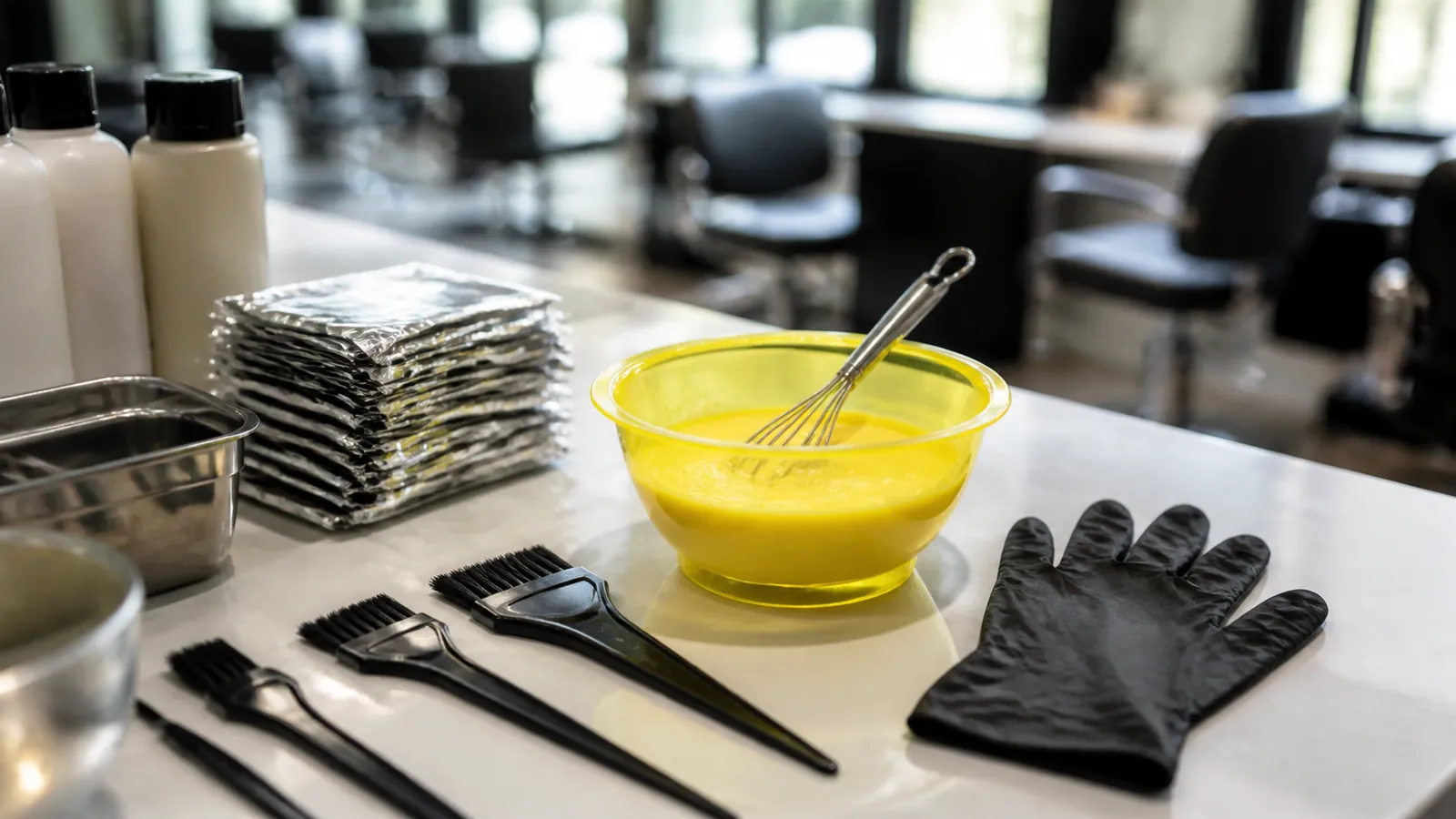
The central coverage split for a stylist is between what happens around your work and what someone alleges about your work. These paired scenarios raise different questions:
| Scenario | The coverage question it raises |
|---|---|
| A client trips over a dryer cord or slips on a wet floor near your station | Third-party bodily injury around your premises or operations — typically a general liability question, subject to policy wording |
| A client alleges that bleach timing, a chemical process, an extension install, or a hot tool caused burns, breakage, or hair loss | An allegation tied to the professional service itself — typically a professional liability question, subject to the covered-service list and policy wording |
Neither row is a promise of payment: the facts of the claim and the actual policy language control, and a single incident can raise both questions at once. The category-level comparison — what each policy type is built for, and where they meet — belongs to general liability vs. professional liability; this page applies it to styling claims.
Professional coverage for a stylist is a service-list and policy-form question before it is a limit question. Current beauty programs may publish broad included-service lists, but every modality you actually perform — color, bleach, smoothing or keratin treatments, extensions, barbering services, add-on treatments — must be checked against the current list and the policy form, along with exclusions and whether the form is occurrence or claims-made. If a service you offer is absent or ambiguous, that is a quote question to resolve in writing, not a gap to discover in a claim. The broader errors-and-omissions category, including consultants and other service trades, lives at the professional liability insurance hub.
Products deserve the same discipline, because "products" is three different exposures. Products used during a covered service may fall within a policy's products language, within its scope. Products sold at retail are a separate exposure that a service-focused policy may treat differently or exclude. Products you private-label or manufacture are a third exposure that typically requires its own review. A marketing page that says "product liability included" does not tell you which of the three it means; disclose all product activity in the quote and get the boundary in writing. An adverse reaction tied to an excluded service or an excluded product is exactly the kind of claim that policy wording, not category names, decides.
Client waivers and patch-test practices are risk-management inputs — genuinely useful ones — but a waiver is not coverage, does not bind an insurer, and may or may not affect a claim depending on the jurisdiction and facts. Treat waivers as one input alongside insurance, never as a substitute for it.
The words in your contract, translated
Salon leases, suite agreements, and venue contracts use six terms that decide whether the policy you bought actually satisfies the clause you signed. You will be asked to produce them; you should be able to read them. Form designations below are the standard Insurance Services Office commercial general liability endorsement families; your carrier may use its own proprietary equivalents, and the endorsement actually attached to your policy is what counts.
| Term | What it actually does | Who it protects | Does a certificate alone deliver it? | What to ask for |
|---|---|---|---|---|
| Certificate holder | Names the party the certificate was issued to, so they receive it and any notices the policy provides | Nobody, in coverage terms — it is an address line | It is the certificate's own field, and it grants nothing | Give the requester's exact legal name and mailing address |
| Additional insured | Amends the "who is an insured" section so a named party has insured status for a defined relationship. For a booth or suite landlord that is normally the managers-or-lessors-of-premises form, CG 20 11. For a venue or client engagement that is not construction work, the designated-person-or-organization form, CG 20 26, is the usual catch-all; the owners-lessees-contractors forms below are written for construction-style agreements | The salon, suite operator, landlord, venue, or client named on the endorsement | No. Status comes from the endorsement or a qualifying policy provision, never from the certificate | The specific endorsement by form number and edition date, whether it covers ongoing work only or completed work as well, its cost, and its processing time |
| Ongoing vs. completed operations | Two different additional-insured endorsements. CG 20 10 responds to claims arising while the work is going on; CG 20 37 is the separate form needed for claims arising after the service is finished (IRMI on additional insured status and waivers of subrogation, reviewed August 6, 2026) | Whoever the contract requires, for the period the contract requires | No | Ask which of the two your contract requires and which one the carrier is actually attaching |
| Waiver of subrogation | Gives up your insurer's right to recover from the named party after paying a claim. It is a separate endorsement from additional-insured status, and it does not make your policy primary (IRMI: subrogation and the CGL policy, reviewed August 6, 2026). On the liability side the scheduled form is CG 24 04, with CG 24 53 as an automatic version; the workers' compensation equivalent is a separate endorsement again, WC 00 03 13 | The salon, landlord, or venue named in it | No | The waiver endorsement by form number, and confirmation it applies to the right line of coverage |
| Primary and noncontributory | A separate endorsement again — CG 20 01 — deciding how your policy shares a loss with the other party's policy: yours responds first and does not seek contribution from theirs | The party named as additional insured | No | The endorsement itself by form number, not a certificate box ticked next to the words |
| Occurrence vs. claims-made | An occurrence form responds to injury that happened during the policy period, whenever the claim arrives. A claims-made form responds only while it is in force and only to claims after its retroactive date — so cancelling it can end cover for work already performed | You | Not applicable — this is a policy form question, visible on the declarations | Which form you are being sold; if claims-made, the retroactive date and what happens at cancellation |
| Per occurrence vs. annual aggregate | Two limits, not one. The per-occurrence limit caps what the policy pays for any single claim; the annual aggregate caps what it pays across the whole policy year — and once the aggregate is spent, the policy is spent, whatever happens next | You | It shows both figures. It does not show how much of the aggregate has already been used this year | Both numbers, and whether defense costs erode the limit or sit outside it |
One further term appears in salon and venue leases and is not insurance at all: indemnity. An indemnity clause is a promise you make to pay for someone else's loss. It can be written far more broadly than any policy will back, and the gap between the promise and the coverage is yours personally. If a clause asks you to indemnify a salon or venue for anything beyond your own negligence, that is a question for a lawyer before you sign, not for a quote form after. Many states also limit by statute how broadly one party may be required to indemnify another, and the limit differs by state and by contract type — whether the clause in front of you is enforceable where you work is a question for a lawyer in your state, not one any policy answers.
Where you work, what you own, and who needs a COI
Locations first. Each place you work carries its own premises question — who controls the space, and which written agreement applies there:
- Employee station or rented booth or chair: the salon controls the premises; the employment or rental agreement applies.
- Salon suite: the suite operator controls the building; the suite lease applies.
- Owned or leased salon: you control the premises; your lease or deed and your own policy apply.
- Client homes and event venues: the client or venue controls the premises; venue contracts often carry their own COI and additional-insured requests.
- Home studio: your home — where the home policy boundary below decides more than most stylists expect.
- Multiple salons or states: each location and state is a separate quote input; do not assume one policy travels.
The home policy boundary. Homeowners and renters policies are written for personal living, and business activity conducted at the home is commonly excluded or heavily limited — including liability for a client injured in your studio, and the retail inventory and professional equipment you store there. Working from home does not extend your home policy to your work; in most cases it does the opposite. Ask your home insurer in writing what is excluded, disclose the home operation on every commercial quote, and treat home-stored stock as property to be scheduled. The general home-business boundary is worked through at home-based business insurance.
The vehicle boundary. A personal auto policy commonly excludes or restricts business use, and a mobile stylist driving between client homes and venues with a kit in the vehicle is squarely inside that question — as is an employee running salon errands in their own car. Tell your auto insurer exactly how the vehicle is used, ask whether the personal policy responds, and ask any commercial quote whether hired and non-owned auto is included. This is the cheapest gap on the page to close and one of the most commonly discovered after a loss.
Property next. Separate what moves from what stays. Portable kit — shears, clippers, dryers, irons, color tools, a POS device, product carried to appointments — is usually an inland marine question — the coverage family written for property that travels, sold to stylists as a tools-and-supplies or portable-equipment route — with its own limit, deductible, and transit and storage terms. Fixed property — furniture, wash stations, tenant improvements you paid for, retail stock on shelves — is a commercial property or BOP question, shaped by the lease's responsibility split. For each class, know ownership, replacement value, storage, and valuation basis, and ask whether business income or equipment breakdown coverage applies to a fixed location.
Then the contract-to-certificate workflow. When a salon, suite, landlord, venue, or client asks for proof, translate the request into fields before you shop:
- The requester's exact legal name and mailing address (the certificate holder).
- The policy types and limits demanded, and for which locations and dates.
- Any exact endorsement wording requested — additional insured, waiver of subrogation, primary and noncontributory, or specific cancellation-notice language. Each of those is defined in The words in your contract, translated.
- Who must issue the proof: the carrier or an authorized producer — not you, and not an editing tool.
Bind valid coverage first; then have the carrier or authorized producer issue the certificate and process any endorsements. Each issuer publishes its own certificate workflow, and what each reviewed path publishes is recorded with its check date in the evidence table below rather than generalized here — but custom endorsement wording and the requester's acceptance of your proof are separate steps with their own timelines whatever the issuer's turnaround. The general mechanics of certificates, holders, and endorsements belong to how a certificate of insurance works; this page's rule is narrower: never present proof without a valid policy behind it, and verify each requirement against the document that governs it.
Do you need workers' compensation? Your state decides
This is the one question on the page where a wrong answer can be a criminal matter rather than an uncovered claim, and it is the question where national guidance is most dangerous: the rule changes at the state line, and it changes on facts — control, payment, duties — rather than on the word printed on a rental agreement. "Booth renter," "1099," "assistant," "substitute," and "independent contractor" are descriptions, not legal conclusions.
Three things are true almost everywhere and worth knowing before you look up your own state. A sole operator with no workers is usually outside the requirement, though they may often elect coverage for themselves. Hiring anyone — including part-time, seasonal, family, or fill-in help — is the event that changes the answer. And a state can treat someone as your worker even though you issue them a 1099 and even though both of you signed something calling them independent.
Four states where you cannot buy workers' comp from a private insurer
In four states, workers' compensation is sold only by a state fund; a private policy bought elsewhere is not valid coverage there. North Dakota's Workforce Safety & Insurance identifies these four as the remaining monopolistic systems in the United States (WSI legislative overview, reviewed August 6, 2026). If you operate a salon in one of them, or you are a stylist who moves across a state line to work, this changes where you buy and what you are left without.
| State | Where coverage is bought | Who must be covered | Authority · verification status |
|---|---|---|---|
| North Dakota | Workforce Safety & Insurance only. North Dakota law does not allow private insurers to underwrite workers' compensation in the state, and there is no self-insurance option | With limited exceptions, all employers must insure all employees — full-time, part-time, seasonal, and occasional — before employees begin working. WSI can issue a cease-and-desist order, and penalties include $10,000 plus $100 for each day the violation continues | WSI coverage requirements · Verified August 6, 2026 |
| Ohio | Ohio Bureau of Workers' Compensation, or an approved self-insurance privilege | Employers with one or more employees | Ohio BWC · Verified with limitation August 6, 2026 — BWC states the one-or-more-employees rule, but its current pages render through script and could not be captured as static text on the check date; confirm directly with BWC before relying on it |
| Washington | Washington State Department of Labor & Industries, or certified self-insurance. Washington does not allow private workers' compensation coverage | Employers with workers. L&I states that if you have workers — whether employees or independent contractors — you may be required to provide coverage, and directs employers to its independent-contractor test | L&I: do I need a workers' comp account? · Verified August 6, 2026 |
| Wyoming | Department of Workforce Services for required industries. Wyoming is the one exception to the monopolistic pattern: coverage is mandatory only for industries the statute classifies as extra-hazardous, determined by your NAICS business activity. Businesses outside that list have optional coverage and may elect DWS coverage or seek a private carrier | Employers in extra-hazardous industries, before work begins. Every business registers with DWS so DWS can determine which category applies to it | Wyoming DWS: employers · Verified August 6, 2026. Whether a salon falls inside or outside the extra-hazardous list is a DWS classification decision, not something this page can state for you — ask DWS to confirm your NAICS classification in writing |
The consequence most salon owners in these states never hear about. A private workers' compensation policy has two parts: statutory benefits for the injured worker, and employers liability — the part that answers a lawsuit brought by an employee or their family alleging the employer caused the injury. Monopolistic state funds provide the first and not the second. The Indiana Compensation Rating Bureau states the position plainly and names the mechanism: the state fund provides statutory workers' compensation coverage but not employers liability coverage, and the gap is filled by an Employers Liability Coverage Endorsement — form WC 00 03 03, with a state-specific WC 34 03 01 created for Ohio exposures (both forms are now in their C edition; ask which edition is attached) (ICRB: employers liability — stop gap, reviewed August 6, 2026). For an employer whose only exposure is in a monopolistic fund state, that stop-gap endorsement is normally attached to the general liability policy rather than to a workers' compensation policy (IRMI: stop-gap endorsement, reviewed August 6, 2026).
If you own a salon in North Dakota, Ohio, Washington, or Wyoming and you have staff, stop-gap employers liability is a separate purchase and nobody is obliged to remind you. Ask for it by name when you quote general liability.
What your state requires, and who can be left off
Eighteen jurisdictions are verified below against their own governing authority. This is not a fifty-one-jurisdiction rule table and does not present as one — the requirement in every other state and the District of Columbia was not verified for this edition, and each one is named and routed to its own agency in the directory that follows. Do not read an absence here as "no requirement." Coverage rules also change; each row carries its check date, and this table is reviewed at least semiannually and immediately on a known change.
One rule cuts across several of these states and is the one salon owners most often get backwards: an owner or officer who elects exemption is removed from the policy, not from the count. Georgia, Tennessee, North Carolina and Wisconsin each say so in their own words below. A salon with four stylists and one exempt owner-officer is a five-person employer in Tennessee, and it needs coverage.
| State | When workers' comp is required | Who may be left off, and how | Authority · checked |
|---|---|---|---|
| Alabama | Five or more employees, other than contractors. "Employee" includes all full- or part-time employees, officers of a corporation, and members of an LLC | Below five, coverage is not required and may be carried voluntarily. Sole proprietors, partners and LLC members are not automatically covered but may opt in | Alabama Department of Labor · August 6, 2026 |
| California | Employers are required by law to carry workers' compensation even with only one employee | A sole proprietor with no employees is not required to cover themselves. Officers and directors must be included unless they elect exclusion by executing a written waiver — available where the corporation is fully owned by those officers and directors, and separately where the individual owns at least 10% of issued stock and is covered by a health plan. A general partner or an LLC managing member receiving wages may likewise elect exclusion by written waiver. The election is never automatic: it requires a signed waiver, and it removes the individual, not the obligation to cover staff | CA DIR, Division of Workers' Compensation, DWC employer FAQs and California Department of Insurance · August 6, 2026 |
| Florida | Outside construction and agriculture: four or more employees, counting business owners who are corporate officers or LLC members | Corporate officers and LLC members may apply to the Division for an exemption, filed online. Sole proprietors and partners in non-construction work are not counted as employees. Construction is a stricter, separate rule at one employee | Florida DFS, Division of Workers' Compensation · August 6, 2026 |
| Georgia | Three or more persons regularly employed, including regular part-time and seasonal workers. Where the business is a corporation or an LLC, the officers or members are included in the employee count | Officers and members may apply to exempt themselves — but an exempt officer still counts toward the three, so the exemption does not remove the business from the requirement | Georgia State Board of Workers' Compensation · August 6, 2026 |
| Michigan | Three or more employees at one time, including part-time — or one or more employees working 35 hours or more per week for 13 weeks or longer during the preceding 52 weeks | A partner is an employee of the partnership, a corporate officer an employee of the corporation, and an LLC member who is a manager an employee of the LLC. A sole proprietor is never an employee of their own sole proprietorship | Michigan LEO, Workers' Disability Compensation Agency · August 6, 2026 |
| Mississippi | Five or more employees regularly employed | Below five, coverage is not mandatory but may be provided voluntarily. Domestic and farm labor sit outside the law unless the employer provides coverage voluntarily | Mississippi Workers' Compensation Commission · August 6, 2026 |
| Missouri | Five or more employees. Construction is a stricter, separate rule at one or more | An employer below the threshold may elect to come under the law. An exempt employer that declines coverage remains exposed to civil suit by an injured worker — the liability does not disappear with the requirement | Missouri DOLIR, Division of Workers' Compensation · August 6, 2026 |
| New York | Virtually all employers must provide coverage for their employees (WCL §2 and §3), and must post notice of coverage at the place of business (WCL §51) | A sole proprietor with no employees is not required to carry it and may cover themselves voluntarily. Once there are employees — including part-time, borrowed, leased, family, and volunteers — coverage is required | NYS Workers' Compensation Board and sole proprietorships · August 6, 2026 |
| North Carolina | Three or more employees regularly employed in the same business or establishment (NCGS §97-2(1)). The test is a pattern of employment across the year, not a headcount on the day of an injury | Sole proprietors, partners and LLC members are not automatically counted toward the three. A corporate officer who elects exclusion still counts toward it | North Carolina Industrial Commission · August 6, 2026 |
| North Dakota | All employers, all employees, before work begins — with limited exceptions | State fund only; no private market and no self-insurance. See the monopolistic table above | ND WSI · August 6, 2026 |
| Ohio | One or more employees | State fund or approved self-insurance only. See the monopolistic table above, including its verification limitation | Ohio BWC · Verified with limitation, August 6, 2026 |
| South Carolina | Four or more employees regularly employed, full- or part-time. Part-time workers and family members are counted as employees | Businesses with fewer than four employees, or with an annual payroll under $3,000, sit outside the requirement. An employer that voluntarily buys coverage stays subject to the Act until it files Form 38 to withdraw | South Carolina Workers' Compensation Commission · August 6, 2026 |
| Tennessee | Five or more full- or part-time employees outside construction and coal mining. Construction service providers and coal mining are a stricter rule at one employee | Corporate officers and family members meeting the definition of employee count toward the five whether or not they are exempt. An employer whose workforce drops below five may withdraw by filing a Notice of Withdrawal (Form I-3) | Tennessee Department of Labor and Workforce Development · August 6, 2026 |
| Texas | Not required for most private employers — Texas is the exception nationally. Private employers choose whether to carry it | An employer that opts out is a "non-subscriber" and takes on obligations instead of shedding them: post a notice of no coverage in the workplace, give written notice of no coverage to new employees, and file the DWC Form-005 with the Division. Opting out also gives up the liability limitation that coverage provides — a non-subscriber can be sued directly by an injured worker | Texas Department of Insurance, Division of Workers' Compensation, non-subscriber requirements and DWC Form-005 · August 6, 2026 |
| Virginia | More than two employees. "Employee" is read broadly and includes part-time, seasonal and temporary workers, minors, trainees and working family members. Where a business hires subcontractors to assist in its trade, the subcontractors' employees are added to the count | Confirm owner, officer and member treatment with the Commission before assuming an election is available to you | Virginia Workers' Compensation Commission · August 6, 2026 |
| Washington | Employers with workers; L&I applies its own independent-contractor test rather than accepting the label | State fund or certified self-insurance only. See the monopolistic table above | WA L&I · August 6, 2026 |
| Wisconsin | Three or more full- or part-time employees — or fewer than three where gross combined wages reach $500 in any calendar quarter, in which case coverage is required by the tenth day of the first month of the next quarter | In a closely held corporation of no more than ten stockholders, one or two officers may exclude themselves, by an endorsement naming each excluded officer. An excluded officer is still counted as an employee. LLCs with members and no employees are not required to carry it | Wisconsin DWD, Worker's Compensation Division · August 6, 2026 |
| Wyoming | Mandatory for extra-hazardous industries as classified by NAICS; optional for the rest, though every business must register so DWS can determine which applies | Where coverage is optional, the employer may elect state fund coverage or seek a private carrier. Owner and officer elections have their own filing windows and minimum durations — ask DWS | Wyoming DWS · August 6, 2026 |
Two jurisdictions where current sources disagree, and this page will not pick a side. For South Dakota, some current summaries describe workers' compensation as voluntary for private employers while others describe it as mandatory; for Rhode Island, published employee thresholds differ between sources. Neither conflict was resolved against the governing authority for this edition, so neither is stated here as a rule. Both agencies are linked in the directory below, and both are the only authority on the answer.
Two deadlines with real consequences. In Texas, the non-subscriber notice (DWC Form-005) has three separate windows: annually between February 1 and April 30, within 30 days of hiring your first employee, and within 10 days of terminating coverage — and again within 10 days if the Division asks for it. The exposure of missing them is not just the filing penalty but the loss of the liability protection you assumed you had. In North Dakota, coverage must be in place before employees begin working, and the penalty structure — $10,000 plus $100 per day — accrues while you sort it out. Neither is curable by buying coverage after an injury.
Find your state's workers' compensation agency
Every U.S. state and the District of Columbia is listed, including the eighteen verified above. Territories are covered in the source directory. Agency names and links are as published by the U.S. Department of Labor's State Workers' Compensation Officials directory, checked August 6, 2026. If your jurisdiction is not in the verified table above, this is where your answer comes from — not from this page and not from a national summary. Ask the agency three questions: does my arrangement require coverage, how does this state treat booth renters, assistants and substitutes, and can an owner or officer be left off without changing the employee count.
The method for reading any state's rule — and the fifty-state detail this page deliberately does not duplicate — belongs to how workers' comp requirements work by state. Salon owners shopping the coverage itself should start at the workers' compensation hub; a first hire also triggers non-insurance steps covered in the first-employee checklist.
Is a license or a bond the same as insurance? And what a quote needs
Licenses, permits, bonds, and insurance are separate fields. A cosmetology license, a business license, a facility or booth permit, a surety bond, and an insurance policy are different instruments issued by different authorities, and holding one proves nothing about the others. A bond in particular is not insurance: it guarantees payment to a customer or the state, and the surety that pays then seeks repayment from you — the risk stays yours. Verify license and permit questions with your state cosmetology board and local authority directly, and ask them four specific things rather than "what do I need":
- Which license class covers every service I actually perform, including any I am adding?
- Does my location need its own establishment, salon, or booth permit separate from my personal license — and who holds it, me or the salon owner?
- Does this state require a bond, and if so for what and payable to whom?
- Does the board require proof of insurance for licensure or renewal, and at what limits?
Cover My Trade does not publish state-by-state cosmetology licensing rules; the board that issues your license is the only authority on them.
The quote-preparation checklist. Bring the same inputs to every path so the quotes you get back are comparable:
- Business: legal entity or DBA; address and every state you work in; years operating; your actual role; annual revenue; claims history; desired limits and deductibles; your deadline.
- Services and products: cuts, color, bleach, smoothing or keratin, extensions, hot tools, barbering, treatments, add-ons; retail sales; any private-label product.
- Locations: employee station, booth or chair, suite, owned or leased salon, client homes, venues, home studio, multiple states.
- People: owner, employees, assistants, substitutes, renters or contractors; payroll and contractor cost.
- Property and data: portable tools, fixed furniture and equipment, inventory, tenant improvements, storage and transit; booking, payment, and client data systems; any vehicle used for work.
- Documents: the signed salon, suite, landlord, or client requirement; certificate-holder details; exact endorsement wording; your state board and workers' comp agency links. Do not upload contracts, IDs, payroll files, or client data through unapproved forms.
Stop and get qualified help — and match the question to the right professional. A licensed insurance producer in your state, for coverage, placement, and endorsement questions. A construction, business, or contracts attorney, for indemnity clauses, lease insurance wording, and anything you are being asked to sign. Your state workers' compensation agency, for who counts as your worker. Your state cosmetology board, for licensure and facility rules. And your carrier's claims line, immediately, for anything that has already happened — a client injury, a chemical reaction, a theft. A claim should be reported to the carrier promptly even when you are unsure whether it is covered; deciding not to report it is not a way to protect your premium, and late reporting can itself prejudice the claim.
What hair stylist insurance costs, and what the number means
All figures below were verified as of July 20, 2026 against each source's current page; the evidence period for each row appears beside it. Recheck every figure on publication day. No figure here is a market average or a guaranteed quote.
Price is an output of your profile. The main drivers: your state and ZIP; operating model; services and chemicals performed; annual revenue; payroll, employees, and assistant or renter use; limits and deductibles; locations; contract-required endorsements; tools and property values; retail product sales; claims history; policy term; and the payment plan and its fees. Two stylists buying "the same" policy can pay differently on almost every one of those inputs — which is why the type of price evidence matters as much as the number.
| Evidence type | What it can support | What it cannot support |
|---|---|---|
| Live bindable quote | A price for one documented business profile on a stated date | Anyone else's price, or a market average |
| Indication | A rough pricing signal pending underwriting | A bindable price or a promise of availability |
| Provider-published fixed or starting price | That the provider currently advertises this figure for its packaged program | That you qualify, that your services are included, or a market rate |
| Marketplace percentile estimate | A methodology-labeled slice of past policy sales | A typical price, a package total, or your quote |
| Marketplace median | The central tendency of that marketplace's own mix | Cross-market comparison or profile-matched pricing |
| Cover My Trade premium sample | A dated, reproducible illustration with a fully documented profile | Nothing yet on this page — see the status note below |
Dated price evidence for hair stylists
| Path | Published figures | Evidence type | Included, as published | As-of / period | Before you rely on it |
|---|---|---|---|---|---|
| Beauty & Bodywork Insurance — individual cosmetology (source) | $96 per year or $9.99 per month, starting price | Provider-published starting price | Packaged individual cosmetology program with published limits, mobile-work framing, priced additional-insured option, and an occurrence-form statement for newer policies | Page reviewed July 20, 2026 (crawled July 18, 2026) | Marketing page, not a quote or policy form. Verify the current service list, eligible states, issuing carrier, fees, exclusions, product-sales boundary, and proof terms |
| Beauty & Bodywork Insurance — salon owner (source) | From $349 per year for 1–2 stations, station-based tiers | Provider-published starting price | Separate salon-owner program priced by station count, with optional tools/supplies tiers and a rented-location eligibility statement | Page reviewed July 20, 2026 (crawled July 19, 2026) | A different insured setup from the $96 individual path — never compare the two as like-for-like. Confirm named insureds, contracted-technician treatment, owned-premises eligibility, and that workers' comp is separate |
| Elite Beauty Society — hairstylist plan (source) | $179 for one year; $299 for two years; $149 part-time; $49 student; published $2M occurrence / $3M annual aggregate limits | Provider-published plan prices | Group/program plan for beauty professionals that its page states includes booth renters and mobile stylists | Page shows a July 13, 2026 update; accessed July 20, 2026 | Verify the covered-service list and exclusions, membership and group-program terms, the broker/carrier structure and any surplus-lines notice, and the additional-insured process. Do not rely on broad protection marketing claims |
| Simply Business — cosmetology routes (source) | Professional liability $28.33/mo; general liability $20.75/mo; BOP $33.75/mo; equipment $20.83/mo; workers' comp $38.91/mo | Marketplace 10th-percentile estimates | Separately quoted coverage routes from a multi-carrier application — not a package | Estimates from relevant policies sold July–December 2025; accessed July 20, 2026 | Tenth-percentile figures by definition sit below what most buyers paid. Do not add the lines into a package total; the carrier, forms, fees, down payment, state eligibility, and endorsement timing are quote-specific. Source conflict: this provider's cosmetology cost page states a January–June 2025 sample period for the same estimate class, while the page cited here states July–December 2025. Confirm the current period before relying on either figure |
Three rules keep these numbers honest. Do not average them — a fixed program price, a 10th-percentile estimate, and a station-based salon tier describe different products, insureds, and methods, and no blend of them is "what hair stylist insurance costs." Treat unstated fees, taxes, and deposits as unknowns to verify, never as zero. And remember what is missing from every row: your state, revenue, services, claims history, and limits — the fields that set your price.
A worked example, built from the one profile on this page that is fully documented. Take the narrowest real stylist profile the evidence above describes: a solo booth renter, cuts and color only, no employees, no retail shelf, one location, working at the published limits of a packaged individual cosmetology program. That is the profile behind the $96-per-year figure in the table — a documented, dated, provider-published starting price for a defined packaged product, and the only anchor on this page with a profile attached to it.
Everything a real stylist adds to that profile moves the number, and the direction of each move is knowable even when the amount is not. The table below decomposes it. It gives directions, not prices. No dollar figure appears in it, because putting one there would require quotes this page does not have — and a made-up spread would be worth less than an honest arrow.
| Profile | What changes from the anchor | Direction | Why |
|---|---|---|---|
| Low — the anchor itself | Solo booth renter, cuts and color, no employees, no retail, one location, program's published limits | The published starting price is the floor of that program, not of the market | Packaged programs price a narrow, pre-defined risk. You either fit the definition or you are quoted something else entirely |
| Base — the same stylist, real book | Adds bleach, smoothing or keratin, extensions and hot-tool work; adds a second working location; raises limits to meet a suite lease | Up, and the professional-liability side moves first | Chemical, smoothing and extension work is where the service-allegation exposure sits. The general-liability side barely notices; the covered-service list and the professional rate do |
| High — the same stylist, now an employer | Hires one assistant; opens a retail shelf; takes venue and client-home work | Up, and it stops being one decision | A first hire adds a separate workers' compensation policy with its own state rule, its own classification and its own audit. Retail adds a products exposure a service-only form may not carry. Venue work adds a covered-locations question before it adds a price |
The single driver that moves the spread most is worker status. Every other change on that table adjusts a rate. Adding a person changes how many policies you buy, brings in a state law that differs at the state line, introduces a classification and an experience modification, and creates an audit that can send a bill after the year is over. Nothing else on the list does all five.
Four smaller directions are worth carrying into a quote conversation. Raising a limit from $1M to $2M per occurrence rarely doubles a price, because the highest-frequency losses sit in the first layer. Moving from a fixed salon chair to mobile and venue work changes the covered-locations question before it changes the price. A prior claim changes underwriting appetite, not just the rate. And a fixed-price program and an auditable policy behave differently at the end of the year even when they quote alike at the start. Bring the profile; the quote will price it.
Cover My Trade premium sample: status Blocked. No CMT-controlled premium sample is published on this page yet, because a compliant sample requires a dated live quote or reproducible indication with every documented profile field — geography, operations, revenue, payroll, limits, deductible, endorsements, fees, and carrier. Until one exists, the figures above are provider evidence only, not CMT samples, market benchmarks, or Trade Premium Index data.
Premium is an estimate until audit
Most liability and workers' compensation premiums are calculated from estimated revenue, payroll, or worker counts at the start of the term and reconciled at the end of it under the policy's audit provision. The number on your quote is a starting figure, not a settled bill. Fixed-price program policies are the exception rather than the rule — ask which kind you are buying, because it changes what a cheap quote actually means.
For a salon owner, this is where the largest and least expected bill comes from, and it comes from the people around your chairs.
Payments to renters, assistants, substitutes, and contracted technicians who cannot produce their own current coverage are commonly treated as your payroll at audit. The person who called themselves independent all year becomes a rated exposure at reconciliation, and you pay for them retroactively. There is a second, heavier consequence running alongside the premium one: an uninsured worker's injury can become your liability, not theirs.
That second consequence is not hypothetical, and in some states it is written into the statute. Florida's Division of Workers' Compensation states that where a subcontractor does not carry workers' compensation for its employees, those workers become the employees of the contractor (Florida DFS coverage requirements, reviewed August 6, 2026) — that rule is written for construction, but it shows the direction the law travels when a paying business uses uninsured labor. Washington L&I tells employers plainly that having workers, whether employees or independent contractors, may trigger a coverage obligation (L&I, reviewed August 6, 2026). North Dakota penalizes a contractor that uses a subcontractor operating under a cease-and-desist order (WSI, reviewed August 6, 2026).
What to collect from every renter, contracted technician, assistant, and substitute — and when:
- A current certificate of insurance naming their general liability and professional liability, in their own business name, before their first shift.
- Their own workers' compensation coverage, or a documented state-permitted exemption or exclusion election — not a verbal assurance and not a 1099.
- A signed agreement stating what they must carry, at what limits, and that lapsed coverage ends the arrangement.
- A re-collection at every policy expiry date, diarised in advance. A certificate is evidence on its issue date and nothing more; a policy cancelled the following week leaves a certificate that still looks valid.
- The whole file kept for the audit period, because the audit is where you will be asked to prove it.
How your work gets classified, and why it changes the bill
One field decides more of a workers' compensation bill than most owners realize: the classification assigned to your payroll. A workers' compensation premium is payroll per classification multiplied by a rate per $100 of payroll, then adjusted for your claims history — so the class your work sits in is not paperwork, it is the multiplier.
Salon and barbering work sits in a single broad national class code, NCCI 9586 — barber shop, beauty parlor, or hair styling salon, which covers personal grooming services involving hair, scalp, face and hands: shampooing, dyeing, cutting, shaping, straightening, setting, drying, permanent waving and hairpiece fitting, plus facial massage, shaving and beard trimming, and nail care. The corresponding general-liability classifications are 10113 for barber shops and 10115 for beauty parlors and hair styling salons. Two things follow from that, and both cost money when they are missed.
Adding a service can move you out of the class. These are the common boundaries for a salon menu:
| If you add | The classification question it raises |
|---|---|
| Massage, or a health-spa or steam facility operating as its own business | Contemplated by code 9063 rather than 9586 |
| Tanning as a standalone business rather than inside the salon | Also 9063; indoor tanning provided inside a beauty parlor or barbershop stays with 9586 |
| Nail services as a distinct operation | General-liability class 15600 for nail salons, alongside the salon's own classification |
| Cosmetic-medical or medical-grade procedures | Moves toward the medical classifications — a different appetite, a different rate, and outside this page's scope entirely |
| A beauty or barber school | Schools carry their own classifications rather than 9586 |
And the national code is not always the code you get. Some states deviate from the NCCI classification and require their own, and several states rate through an independent bureau rather than NCCI — New York among them. Ask which class code is being applied to your payroll and under whose rules.
Evidence note on this section: class codes and their phraseologies come from NCCI's basic manual and, in independent-bureau states, from that state's own rating bureau. Those manuals are licensed publications rather than open web pages, so no public link is given here and none should be inferred. The code applied to your policy is a fact on your own declarations page — ask your carrier which code it assigned, and in an independent-bureau state confirm it against that bureau. Treat every code named above as the starting point for that question, not as a determination of your classification.
The second field is your experience modification — a factor comparing your own claims history against businesses in the same classification, applied to the manual premium. A new business normally starts at a neutral factor, and a claims record then moves it up or down from there. It compounds: a classification error and a claims record are multiplied together, not added.
An inaccurate classification is not a saving — it surfaces at audit, and it can put a claim in dispute. Describe the work accurately and let the carrier classify it, then ask which classification was applied and why.
Recheck the whole stack when any of these changes — each one can move a covered-service list, a classification, a limit requirement, or a state obligation:
- You add or drop a service, modality, or chemical process.
- You take on an assistant, substitute, renter, or first employee — or one leaves.
- You start selling retail product, or private-labeling it.
- You add a location, work in a second state, or shift between salon, mobile, and home work.
- You sign a new lease, suite agreement, venue contract, or client requirement.
- You have a claim, an incident, or a declined application.
- Your revenue or payroll moves materially away from what you estimated.
- Your policy renews. Re-quote rather than auto-renewing a profile that is two years out of date.
And check the certificate you are handed, rather than filing it. A certificate is a one-page summary and it is easy to accept one that proves nothing:
- Does the named insured match the business you are actually paying? A certificate in a spouse's or a former salon's name covers a different person.
- Are the policy numbers, effective dates, and expiry dates present — and is today inside them?
- Does it list the coverages you required, at the limits you required, or only the ones the holder happened to have?
- If you required additional-insured status, waiver of subrogation, or primary and noncontributory, is the endorsement attached or referenced by form number? A tick in a box on the certificate is not the endorsement.
- Who issued it — a licensed producer or carrier, with contact details? An emailed image with no issuer is not evidence of anything.
Then ask your own carrier four questions before you bind: is this policy auditable or fixed-price; what exposure basis will be audited; which classification is being applied to each worker; and how will payments to renters and contracted technicians be treated if they cannot produce coverage. Get the answers in writing.
Compare buying paths by fit and evidence, not headline price
Path facts verified as of July 20, 2026 from each provider's current first-party pages; recheck on publication day. Inclusion and order follow reader fit and current evidence, not commercial consideration; this is not a ranked "best" list, and no path is an endorsement. Published price evidence for every path lives in the cost table above and is not repeated here.
Who actually issues the policy: provider roles
Know which role you are buying through — it changes who bears your policy, how quotes and certificates flow, and where your data goes.
| Role | Who issues and bears the policy | What the role changes for the buyer |
|---|---|---|
| Direct carrier | The carrier itself underwrites the policy and pays claims | One insurer's appetite and forms; pricing, COI issuance, and claims all run through that carrier |
| MGA / program administrator | An issuing carrier bears the policy; the program designs, sells, and administers it | Program-defined coverage and price; ask which carrier is on the declarations and who issues COIs and endorsements |
| Broker / agency | A carrier bears the policy; the broker or agency places it | Access to multiple carriers; quotes, certificates, and endorsements route through the producer |
| Comparison marketplace | The quoted carrier bears the policy; the marketplace routes your application, and often your data and lead | Multiple quotes from one application; carrier, forms, fees, and service differ per quote — ask how your data is shared |
Where a provider's own current documentation does not state its role, this page labels the role not verified rather than inferring it. The declarations page and legal notices in your actual quote documents control.
The current paths: fit and disqualifiers
| Path (role) | Best for | Not ideal for |
|---|---|---|
| Beauty & Bodywork Insurance — individual cosmetology (specialty packaged program; carrier and administrator role not verified) | An independent stylist, booth or suite renter, or mobile cosmetologist who wants one fixed-price packaged policy to quote first | Salon owners, private-label or manufacturing sellers, or anyone whose services fall outside the published list |
| Beauty & Bodywork Insurance — salon owner (specialty packaged program; role not verified) | A salon owner renting or leasing space who wants one station-based policy covering up to 10 stations | Individual renters — this is a different insured setup — and owners whose premises or worker facts fall outside the program |
| Elite Beauty Society (group/program path; broker/carrier structure not verified) | Independent, booth-renter, mobile, part-time, or student stylists who want fixed annual plan tiers with published limits | Salon entities needing staff or premises coverage, and anyone unwilling to verify a broad marketing claim against the actual form |
| Simply Business (marketplace, multi-carrier) | A stylist who wants multiple carrier quotes from one application, or needs separate workers' comp, BOP, or equipment routes | Anyone wanting one fixed published price without underwriting, or same-day certainty on custom endorsement wording |
The same paths: what the evidence does and does not close
Every path below was reviewed to the same depth — its own current first-party pages — so the gaps are comparable rather than an artifact of uneven research. No policy form was obtained for any path.
| Path | What the reviewed pages published | Certificate issuance, as published | What they did not publish | Confirm in the quote |
|---|---|---|---|---|
| Beauty & Bodywork Insurance — individual cosmetology | Packaged liability program with published limits, an additional-insured option with a stated price, a tools/supplies route, mobile framing, and an occurrence-form statement for newer policies | Its pages state a certificate is available to download immediately after purchase, and describe same-day coverage (reviewed July 20, 2026) | The issuing carrier and the provider's own role; the policy form; total fees and taxes; the boundary between product used in service and product sold at retail | Current covered-service list and exclusions; issuing carrier and role; additional-insured cost and timing; product-sales boundary and total fees |
| Beauty & Bodywork Insurance — salon owner | Station-priced salon program with optional tools/supplies tiers and a rented-location eligibility statement | Not published separately for the salon path (reviewed July 20, 2026) | The issuing carrier and role; exactly who is insured — owner, renters, contracted technicians; owned-premises treatment; the forms | Exactly who is insured; owned-premises treatment; policy forms; workers' comp handled separately |
| Elite Beauty Society | Plan tiers with published occurrence and aggregate limits; a page statement that booth renters and mobile stylists are included; a stated additional-insured process | Not published as a stated turnaround (reviewed July 20, 2026) | The broker and carrier structure behind the plan; any surplus-lines status; the full covered-service list with exclusions; membership and group-program terms | Covered-service list and exclusions; membership/group terms; broker/carrier structure and any surplus-lines notice; additional-insured processing |
| Simply Business | Separate GL, professional, BOP, equipment, and workers' comp routes; a published estimate methodology | A post-purchase certificate workflow is published, without a stated turnaround (source, reviewed July 20, 2026) | The carrier and forms for any individual quote — these are quote-specific by design; fees and down payment; state eligibility by trade; endorsement turnaround | The exact quoted carrier and forms; fees and down payment; state eligibility; endorsement and certificate timing for your contract's wording |
Considered but not profiled: Insureon, a multi-carrier marketplace, was reviewed but did not pass this page's current-evidence gate — its hair-salon cost page was last updated March 18, 2025, and its published figures lack the current profiles this page requires as of July 20, 2026. No further claim about it is made here.
When the answer is no, or not yet
Shortlists assume the market wants your business. Sometimes it does not, and the honest routes look different:
- No program will write your operation. Usually because a modality sits outside every published service list, or requires a license you do not hold, or is treated as cosmetic-medical. Route to a licensed broker with access to surplus-lines markets rather than reapplying to packaged programs; ask specifically which of your services caused the decline. Admitted carriers are licensed by your state and backed by its guaranty fund if the insurer fails; surplus lines carriers are not state-licensed for that line, are free to write risks the admitted market declines, and generally carry no guaranty-fund protection — which is a trade-off to understand, not a reason to refuse a placement you cannot otherwise get.
- The required limits cost more than the work is worth. A limit in a lease or venue contract is a contract term, and contract terms can be negotiated before they are signed. Ask the salon or venue what limit they will accept, in writing, before you buy to a number nobody has justified. Where a limit genuinely has to be met, ask about an umbrella or excess policy as well as a higher underlying limit — an umbrella sits above the policies it schedules and is often the cheaper route to a contract number, but it only covers what the underlying policies cover, so it closes a limit gap and never a coverage gap.
- You have a prior claim or a declined application. Disclose both on every subsequent application. Non-disclosure is a route to a rescinded policy and an unpaid claim, which is a far worse position than a higher rate.
- You are working uninsured right now. Say so plainly to a licensed producer in your state and buy prospectively today; coverage cannot be backdated to reach something that has already happened, and asking for that is fraud rather than a shortcut. If an incident has already occurred, report it and take advice — you are not the first person in that position, and the exposure only grows while it is unaddressed.
- You have been cancelled or non-renewed mid-lease. Check the notice provision in the salon or suite agreement — many require you to inform the landlord — and re-quote immediately rather than at expiry. Continuing to work while the salon believes you are covered is a problem in its own right.
Whatever path you choose, the coverage you end up with is set by the policy issued to you — not by any table, including this one.
Choosing a provider at a glance
Picks reflect the same evidence, dates, and caveats as the tables above (verified as of July 20, 2026). Every pick is an option to quote — eligibility and price are underwriting-dependent, and none is a recommendation to buy or a promise of coverage.
- Best for a solo booth or suite renter who wants a fixed-price individual policy to quote first: Beauty & Bodywork Insurance's individual cosmetology path or Elite Beauty Society's hairstylist plan — confirm your exact services appear on the current covered list before paying.
- Best for a part-time or student stylist: Elite Beauty Society, which publishes part-time and student tiers — confirm how it defines each tier and what the group-program terms require.
- Best for a salon owner renting stations: Beauty & Bodywork Insurance's separate salon-owner path — confirm precisely who is insured before comparing it with any individual policy.
- Best for a stylist who wants multiple carrier quotes, or separate workers' comp, BOP, or equipment routes: Simply Business's marketplace — the carrier, forms, fees, and price are quote-specific.
- Best when your governing requirement is unresolved — workers, an unclear contract clause, or a state question: confirm the requirement first through your state's workers' compensation agency or the written contract, then quote.
| Your situation | Shortlist move | Confirm in the quote |
|---|---|---|
| Solo booth or suite renter, no workers | Quote both specialty individual paths and one marketplace route on identical inputs | Covered-service list and exclusions; additional-insured availability, cost, and timing; certificate workflow; occurrence vs. claims-made |
| Mobile or home-based stylist | Quote paths whose current pages address mobile or home work, and disclose every location | Covered locations and territory; tools in transit; client-home and venue work; the home-policy and personal-auto boundaries |
| Salon owner with stations or staff | Quote the station-based salon path plus a marketplace or broker route for property and workers' comp | Named insureds and renter treatment; premises and tenant improvements; workers' comp filed in your state, and stop-gap employers liability if that state is monopolistic; product-sales boundary |
| Any stylist with workers or an unclear insurance clause | Verify the state workers' comp obligation in the state section above and the written clause first, then quote | How the policy treats each worker; the contract's exact endorsement wording; cancellation and audit terms |
One scorecard, every path: use the quote-preparation checklist above as your per-provider scorecard. Submit the same inputs to each path, then compare the returned terms on the same fields — covered services, insureds, limits, deductibles, endorsements, fees, and proof workflow — rather than comparing each provider's own headline framing.
How this page is built, sourced and reviewed
Cover My Trade is an independent editorial publisher, written and maintained by the Cover My Trade editorial team: it is not an insurer, agency, broker, managing general agent, or regulator, it holds no insurance producer license in any state, it does not place coverage, and it cannot issue a certificate. Nothing here is insurance advice, legal advice, a quote, or a binder, and reading this page does not satisfy any requirement.
How claims on this page are sourced. Legal requirements come from the governing state agency, statute, or administrative rule — never from an insurer's blog or a national summary. Endorsement and policy-form points come from rating-bureau or standard-form references, cited by form designation where one exists. Provider coverage, price, and workflow claims come only from that provider's own current pages, and are used only for that provider's own product. Third-party review material is not used as evidence for coverage, price, or requirements.
What this page will not do. It publishes no market average and no "typical" premium, because premium is set by state, operating model, services, revenue, payroll, limits, deductible, and claims history, and a blended figure across all of them describes nobody. It publishes no state rule it has not verified against that state's own authority. Where a figure or rule cannot be verified to that standard, the page says so — the Cover My Trade premium sample above is labeled Blocked for exactly that reason, and the Ohio row carries a stated verification limitation.
Independence and funding. Ordering and inclusion on this page follow reader fit and current evidence. No provider paid for placement, position, or inclusion, and no provider reviewed this page before publication. Where Cover My Trade earns commission on a referral, it is disclosed on the page carrying the link; commission does not affect inclusion, ordering, or the disqualifier stated against each path.
Corrections. If a figure, rule, form designation or link on this page is wrong or has gone stale, Cover My Trade wants to be told at hello@covermytrade.com. A correction is handled the same way as a scheduled recheck: the claim is re-verified against its governing source, the cell and its check date are updated together, and where the change is material the page's review date moves with it.
Refresh cadence. Provider prices, terms, and eligibility are rechecked monthly to quarterly and again on publication day. State workers' compensation rules are rechecked at least semiannually and immediately on a known change. Coverage and endorsement explanations are reviewed annually unless a form or regulator position changes. Every dated row above carries its own check date; where a row's date is older than this cadence, treat it as unverified until rechecked.
Frequently asked questions
Does a booth renter need separate hair stylist insurance?
Often, but the contract and the facts decide — not the label. The salon's policy may not insure your own business or services, and rental agreements commonly require your own general liability and professional liability plus a certificate. Read the signed agreement, ask in writing whether the salon's policy names or extends to you, and quote your own coverage for your own work.
Is general liability enough for a hair stylist?
General liability addresses third-party injury and property-damage questions around your premises or operations. An allegation that a cut, color, chemical process, or extension caused harm is a different coverage question, addressed by professional liability or another service-error mechanism — subject to the covered-service list and policy wording. Most stylists need to price both questions, not one.
What does a salon or suite need on a certificate of insurance?
Whatever the written requirement says — typically the policy types and limits, the certificate holder's exact legal name and address, and sometimes endorsement wording such as additional insured or waiver of subrogation. Collect those fields from the requester first, then read each term against the words in your contract, translated — that table names the endorsement each request actually needs.
How fast can I get a COI after buying a policy?
It depends on the issuer, and the honest answer is to check what yours actually publishes rather than to trust a general figure. What each reviewed path publishes about certificate issuance is recorded, with its check date, in the evidence table above — one states a certificate is available to download immediately after purchase; the others publish a workflow without a stated turnaround. Whatever the issuer publishes, the clock is set by the slowest dependency: complete quote inputs, underwriting review, payment or deposit, endorsement processing for additional-insured, waiver-of-subrogation, or primary-and-noncontributory requests, and the certificate-holder details from the requesting party. Endorsements routinely take longer than certificates, and the requester's acceptance of your proof is a separate step again. A COI is evidence of a bound policy, never a substitute for one.
How much does hair stylist insurance cost per month?
No Cover My Trade premium sample is published for this trade yet, so no single honest figure exists. Your price is set by your state, operating model, services and chemicals, revenue, payroll and workers, limits and deductible, tools and property values, product sales, and claims history. Dated provider-published prices and marketplace estimates — each labeled by evidence type, with its period and caveats — appear in the cost-evidence section above; none is an average or a guaranteed quote.
Your next step
Get the signed salon, suite, landlord, or client requirement in hand. Inventory your role, services, chemicals, locations, products, tools, workers, revenue, claims, and deadline. Check your state in the workers' compensation section above if anyone works for you. Then quote at least two paths on identical inputs, compare the returned terms on the same fields, and request proof only after coverage is validly bound and any required endorsement is confirmed in writing.
Sources and last verified date
Last verified: August 6, 2026
Next review: September 6, 2026
- Independent contractor defined — IRS — the federal test behind booth-renter and 1099 status questions.
- Additional insured status and waivers of subrogation — IRMI — the CG 20 10 / CG 20 37 ongoing-versus-completed-operations split.
- Subrogation and the CGL policy — IRMI — what a waiver of subrogation endorsement does and does not do.
- Stop-gap endorsement — IRMI — where the employers-liability stop gap attaches for monopolistic-state employers.
- Employers liability — stop gap — Indiana Compensation Rating Bureau — the state-fund employers-liability gap and the endorsement forms that fill it.
- WSI legislative overview — North Dakota Workforce Safety & Insurance — the four remaining monopolistic workers-comp systems.
- Non-subscriber requirements — Texas Department of Insurance, DWC — Texas's elective comp rule and the DWC Form-005 filing.
- Workers' compensation employer FAQs — California DWC — California's coverage duty for salon employers.
- Coverage requirements — Florida Division of Workers' Compensation — Florida's threshold rule.
- Sole proprietorships — New York Workers' Compensation Board — New York's treatment of stylists with no employees.
- Workers' disability compensation insurance requirements — Michigan LEO — a verified state threshold example.
- Worker's compensation requirements — Wisconsin DWD — a second verified state threshold example.
- Cosmetology insurance — Beauty & Bodywork Insurance — specialty annual-policy terms and price evidence for stylists.
- Hairstylist liability insurance — Elite Beauty Society — a second specialty provider's published terms.
- Cosmetology insurance — Simply Business — marketplace price-estimate evidence.
Beauty & Bodywork Insurance
Instant, cheap annual liability for stylists, estheticians, lash/nail techs, massage, and trainers — often bought and printed in one sitting.
Cover your booth