
Landscaping Insurance: Costs & Coverage
Advertiser disclosure: Cover My Trade may earn a commission when you request a quote or buy a policy through links on this site. It never changes your premium, and it never changes our editorial read — coverage requirements depend on your state, your contracts, and your payroll, and we say so on every page.
The short answer. "Landscaping insurance" is not one standardized policy. General liability is the common starting point for third-party injury and customer-property-damage questions, but the right stack depends on the work you actually perform: mowing and maintenance, pesticide or herbicide application, tree work and height, grading and hardscape, irrigation, snow and ice work, vehicles and trailers, mobile tools, employees or subcontractors, contracts, and carrier underwriting. Two gates decide more than price does. If you apply pesticides or herbicides, verify your state's applicator and business-license rules before you shop. If you employ anyone, your state — not a national rule of thumb — decides whether workers compensation is required. A certificate of insurance can show coverage that already exists; it cannot authorize regulated work or add coverage a policy does not provide.
Need a certificate this week? Start here. What decides whether you make the deadline, in order:
- A certificate is proof of a policy that already exists. No legitimate path issues one without bound coverage, and no certificate adds coverage a policy does not provide.
- Get the written request before you shop. You need the requester's legal name and address, the required policy types and limits, the project and location, the dates, the certificate-holder details, and the exact endorsement wording demanded.
- Endorsements are bought, not typed. Additional-insured status, a waiver of subrogation, and primary-and-noncontributory wording each generally require an endorsement or policy provision, each can carry premium, and each takes longer than the certificate itself.
- Tell the producer your deadline before you quote. The clock is set by the slowest dependency — complete quote inputs, underwriting review, payment, and endorsement processing — not by the certificate.
- Two things not to get wrong. Do not let a deadline push you into a policy that excludes the work you actually do; chemical application and tree work are the usual exclusions. And do not promise a client wording no carrier has confirmed.
The full sequence, including what a certificate holder is and is not, is in how to handle a COI or additional-insured request.
Choose your path. This page covers landscaping and lawn-maintenance businesses in the United States — mowing, maintenance, planting and installation, irrigation, hardscape and grading, chemical application, snow and ice work, and design. It does not cover standalone arborist and tree-service companies, agricultural spraying operations, or landscape architecture as a licensed profession, each of which is classified and regulated separately. Four routes, and the gate that decides which one is yours:
- Choose a general-liability-first quote, with a tools-and-equipment question attached, if your work is mowing, planting, and routine maintenance with no chemical application, no employees, and no contract dictating coverage terms — as an option to quote, not a promise of eligibility or price.
- Choose a stacked quote covering general liability, workers compensation, and commercial auto if you run a crew with payroll, own or haul with business vehicles or trailers, or send employees to drive — again as an option to quote, with eligibility and pricing set by underwriting.
- Choose a contract-first path if a property manager or client has handed you written insurance wording: gather the exact requirement before quoting anything.
- Confirm the requirement first if you apply pesticides or herbicides, work at height in trees, or face unresolved state licensing or workers-compensation questions — start with EPA's applicator-certification page and your own state's authorities in the state layer before comparing prices.

On this page
- What landscaping insurance do you actually need?
- Landscaping coverage and requirement matrix
- What happens at the audit, and what your subs cost you
- Pesticide and herbicide work changes the decision
- The state layer: what changes where you work
- When workers compensation starts, and who can be left off
- Build the coverage stack around your actual operations
- What landscaping insurance costs and what the number means
- Compare quote paths by operational fit, not headline price
- How to handle a COI or additional-insured request
- Prepare the quote accurately and know when to stop
- Class codes and what they do to your premium
- Your situation, your first move
- After you bind: renewals, audits, and when a market says no
- Frequently asked questions
- About this page and how it is maintained
What landscaping insurance do you actually need?
The answer runs through six gates. Work through them in order, because each one can change everything after it.
The six gates that decide your coverage stack
- Exact operations. Mowing, landscape installation, irrigation, hardscape, grading, tree work, design, and snow removal are different exposures with different classifications. The label "landscaper" decides nothing; the service list does.
- Chemical application. Any pesticide or herbicide work — even occasional weed spraying — raises certification, business-licensing, and policy-form questions that routine maintenance never triggers.
- State and local rules. Licensing, registration, workers compensation, and financial-responsibility requirements are set by your state, and sometimes your county. No other state's rule applies to you.
- Workers and subcontractors. Employees generally raise workers-compensation questions under state law; subcontractors raise certificate, contract, and premium-audit questions. Labels alone do not settle worker status.
- Vehicles, tools, and property. Trucks, trailers, hauling, employee drivers, mobile equipment, and a shop or yard each map to different coverage types — none of them automatically handled by general liability.
- Contracts, proof, and underwriting. A client contract may require specific limits, endorsements, and certificates, and a carrier's underwriting appetite decides whether your actual operations are eligible at all.
If you are still deciding which coverage categories apply to your business at all, start with the broader triage in what insurance does my business need?
Your first action — write this list before requesting anything. Every quote path and every requirement check below runs on these facts.
- Every service you sell, and its rough share of revenue.
- The states and counties where you work.
- Any chemical products you apply, their use classes, and your applicator credentials.
- Tree work and maximum working height.
- Typical and largest project values, and your residential versus commercial mix.
- Vehicles, trailers, and who drives them.
- Tools and equipment values, and where they are stored.
- Employees, payroll, and subcontractor costs.
- Annual revenue and past claims.
- The exact wording of any written contract or certificate request you have received.
Proof and license warning. Insurance does not authorize pesticide application, tree work, or any other regulated or licensed activity — government permission and insurance are separate questions, verified separately. A certificate of insurance can summarize coverage that already exists; it cannot add coverage, change a policy, or stand in for one. Any path promising proof without a valid bound policy is not a shortcut; it is a problem.
Landscaping coverage and requirement matrix
Category rows verified against the sources cited in the linked sections as of July 20, 2026 (status: Verified with limitation — the policy form, endorsements, contract, and jurisdiction control every cell). A blank or general cell never means "no requirement," "no fee," "no exclusion," or "covered."
This matrix is the page's primary decision asset. Each row is one landscaping risk or trigger, the instrument that usually answers it, and what to verify. The row IDs carry across both tables below and into the exclusions table, so L-03 means the same thing everywhere on this page. Use the matrix to build your question list, not to conclude coverage.
Table A — the risk, the instrument, and who requires it
| Row | Risk or trigger | Coverage or instrument | Requirement status |
|---|---|---|---|
| L-01 | Third-party injury or property damage during landscaping operations | General liability (GL) | Commonly requested; contract requirement in many agreements |
| L-02 | Damage alleged after a landscaping job is finished | Completed-operations coverage within GL | Underwriting and policy-form dependent |
| L-03 | Pesticide or herbicide application, including drift | Applicator certification + business license + chemical or applicator endorsement question | Legal requirement (federal/state) for certification; coverage is underwriting-dependent |
| L-04 | Tree work, work at height, line clearance | Underwriting classification; sometimes a separate program | Underwriting condition |
| L-05 | Landscaping tools and equipment lost, stolen, or damaged, including in transit | Inland marine / tools and equipment coverage | Optional; commonly purchased |
| L-06 | Owned vehicles, trailers, hauling, employees driving | Commercial auto; hired and non-owned auto | Legal requirement — each state's financial-responsibility law sets the minimum, and commercial minimums differ from personal ones |
| L-07 | An employee is injured working | Workers compensation | Legal requirement, state-dependent — see when workers compensation starts |
| L-08 | Subcontractors on your landscaping jobs | The sub's own coverage plus certificates; your policy's subcontractor terms | Underwriting condition; certificate collection is common practice |
| L-09 | Shop, yard, office, nursery stock | Commercial property or a business owner's policy (BOP) | Optional; exposure-dependent |
| L-10 | Errors in paid landscape design or consulting | Professional liability (E&O) | Sometimes a contract requirement; otherwise optional |
| L-11 | A contract demands limits above your landscaping policies | Umbrella or excess liability | Contract-driven |
| L-12 | Government permission to operate | Business license, applicator certification, county registration, permit | Legal requirement, jurisdiction-dependent |
| L-13 | A client or landlord asks for proof and specific wording | Certificate of insurance plus requested endorsements | Contract requirement |
| L-14 | Snow and ice work in the off-season | Separate disclosure; sometimes separate coverage or exclusion | Underwriting condition |
Table B — what the instrument may address, what it never proves, and what to ask
| Row | What it may address | What it does not prove | Verify or ask |
|---|---|---|---|
| L-01 | Claims by non-employees alleging bodily injury or property damage, subject to wording, exclusions, limits, and listed operations | That every landscaping service you perform is covered; chemical work usually needs separate confirmation | Confirm all operations are listed on the application |
| L-02 | Claims arising after landscaping work is complete | That defective workmanship itself is covered; treatment varies by form | Ask how completed operations applies to hardscape and irrigation |
| L-03 | Legal permission to perform chemical work; possible chemical bodily-injury and property-damage coverage if the form provides it | A generic GL policy name never proves chemical work is covered; a license never proves insurance | See the pesticide section; get written confirmation |
| L-04 | Correct eligibility and pricing for elevated tree work | That a "landscaping" class includes tree work — it is often classified or excluded separately | Disclose heights and methods; ask about tree-work exclusions |
| L-05 | Mowers, trimmers, sprayers, and compact equipment away from your premises | That GL protects your own property — GL addresses liability to others | List values, storage, and transit patterns |
| L-06 | Business vehicle liability and physical-damage questions for trucks and trailers | That a personal auto policy handles business use — verify, never assume | Disclose every vehicle, trailer, and driver; ask whether hired and non-owned auto is included |
| L-07 | Medical and wage benefits for an injured landscaping employee under state law | That GL responds — GL addresses third parties, not your workers | Check your own state's rule and owner-election options |
| L-08 | Contractual risk transfer to landscaping subs; audit and premium treatment | That a sub's certificate stays valid forever, or that your policy picks up uninsured subs | Collect current certificates; ask how uninsured subs are treated |
| L-09 | Your own premises, contents, and nursery stock | That GL covers your own property — it does not address it | Inventory locations and values |
| L-10 | Claims alleging negligent landscape design or advice | That GL responds to a pure design error | Read your contracts' insurance clauses |
| L-11 | Additional limits over scheduled underlying landscaping policies | That it fills coverage gaps — it generally follows underlying terms | Match the contract's limit and wording requirements |
| L-12 | Legal authorization for regulated landscaping activities | None of these prove insurance, and insurance proves none of these | Check the current state or local authority directly |
| L-13 | Evidence of existing coverage; an endorsement may extend defined protections | A certificate alone adds nothing to the policy | Bind first; see the COI section |
| L-14 | Eligibility and pricing for winter snow and ice operations | That a landscaping policy's silence means snow work is covered | Disclose winter work before the season, not after a claim |
Three patterns in these tables decide most real cases. First, operations move rows: adding chemical application, tree work, or an employee does not just add a line item — it can change licensing, eligibility, classification, and price at once. Second, government instruments and insurance instruments never substitute for each other; row L-12 exists because "licensed and insured" bundles two unrelated proofs. Third, every coverage row ends in a policy-form question, which is why the quote checklist below matters more than any provider's marketing page.
Common exclusions to read behind these rows
Table B tells you what an instrument does not prove. This one tells you what a landscaping policy commonly does not pay for. Most general liability policies are written on the standard ISO commercial general liability coverage form (CG 00 01) or a carrier's own version of it; exclusions, edition dates, and endorsements differ between carriers and between editions, so read the form and the schedule attached to your own declarations page rather than any summary — including this one.
| Row | Common exclusions to read on the actual form |
|---|---|
| L-01 | Pollution; damage to property in your care, custody or control; damage to your own work; injury to your employees; liability arising from owned autos |
| L-02 | The "your work" exclusion — damage to your own completed work is commonly excluded, while damage that work causes to other property may be treated differently, and a subcontracted-work exception may or may not apply |
| L-03 | The pollution exclusion is the one that decides most chemical questions; coverage for pesticide and herbicide application, drift, and overspray is typically restored, if at all, only by a specific endorsement |
| L-04 | Height, tree removal, tree climbing, and line-clearance exclusions; some forms exclude work above a stated height |
| L-05 | Wear and tear and mechanical breakdown; theft from unattended or unlocked vehicles; equipment left on a jobsite overnight; items over a scheduled value |
| L-06 | Personal auto policies commonly exclude business use; hired and non-owned auto is a separate coverage from owned-vehicle liability |
| L-07 | The employer's-liability side of a workers-compensation policy carries its own separate limits, and in four states it is not part of the state-fund policy at all |
| L-08 | Your policy's subcontractor provisions rather than an exclusion: uninsured subcontractors commonly become your exposure and your premium, and some forms restrict coverage for work you subcontract out |
| L-09 | Outdoor property, nursery stock, and trees commonly carry sublimits; flood and earth movement are commonly excluded |
| L-10 | Professional liability responds to negligent advice or design, not to bodily injury or property damage from your operations |
| L-11 | Umbrella and excess coverage generally follows the underlying form: a gap below is usually a gap above |
| L-12 | Not applicable — a license, certification, registration or permit is a government authorization, not an insurance policy, and carries no coverage to exclude |
| L-13 | Not applicable — a certificate is evidence of a policy, not a policy; what can be excluded is decided by the underlying form and the endorsements actually purchased |
| L-14 | Snow and ice operations are commonly excluded or separately rated on a landscaping policy, and plowing with a vehicle raises an auto question rather than a general liability one |
Ask for the exclusion pages and the endorsement schedule before you bind, not after a claim. If a carrier will not show you the form, that is itself information.
Two policies you already have that will not cover this business
A personal auto policy is written for personal use and commonly excludes business use — driving between jobs, hauling a trailer, an employee running for materials. A homeowners policy is written for personal risks and commonly excludes business property and business liability: the mowers in your garage, the sprayer in the shed, and a client injured on your property while dropping off a payment are business exposures, not household ones. NAIC consumer material describes typical homeowners limits of $2,500 for business property at home and $250 away, and notes that these policies tend to exclude business-related liability claims (NAIC small-business consumer page, accessed August 5, 2026). Endorsements sometimes narrow these gaps and sometimes do not. Ask your personal-lines agent in writing which of your business activities the policy excludes, and get the answer before you rely on it.
What happens at the audit, and what your subs cost you
Status: underwriting and policy condition — the audit and classification provisions in your own policy, the applicable rating bureau, and your state's rules control. Two state funds are cited below for how they state the subcontractor rule; both verified August 5, 2026. Confirm the treatment in writing with each carrier before you bind.
The premium you agree to at binding is usually an estimate. General liability is commonly rated on projected revenue or payroll and workers compensation on projected payroll, and most policies reserve the right to audit the actual figures after the term ends and to bill or refund the difference. That is why the number you were quoted is not always the number you pay, and why understating revenue or payroll at quote time does not save money — it defers a larger bill and can put the policy itself at risk.
The part that surprises landscaping businesses is subcontractors. Where a subcontractor cannot produce their own coverage for the period they worked, the payments you made to them are commonly recalculated into your payroll at audit, rated at your classification — a charge that lands a year after the work rather than at binding. Two state funds state it plainly in their own words: New York's state fund says that if you cannot produce workers compensation coverage documents for your subcontractors at audit, your premium is recalculated to include them in your payroll, following the rating board's subcontractor guidelines (NYSIF, subcontractor coverage, verified August 5, 2026), and California's state fund says payments to uninsured or unlicensed workers reported on a 1099 may be treated as payroll at audit, and that an unlicensed individual performing work requiring a contractor license is an employee for workers compensation purposes (State Compensation Insurance Fund, employment status and your audit, verified August 5, 2026). Those are two states' rules stated by their own funds, not a national rule — the treatment in your state, and on your policy, is set by your state's rules, the applicable rating bureau, and your policy's audit provisions. A crew of casual help hired for a spring install, a friend with a chipper, a mowing sub in the busy months — all of them can arrive as premium a year later. The certificate that was current in April does not evidence September work, and mid-season expiry is the usual way a covered sub becomes an uninsured one.
Ask every quote path two questions in writing: how do you treat payments to subcontractors who cannot produce a certificate at audit, and what does the policy require me to keep. Then collect this from every sub, before the first day on site.
| What to collect | When | Why it matters at audit |
|---|---|---|
| Certificate showing the sub's own general liability | Before the first day on site | An uninsured sub's pay is commonly charged to you as payroll |
| Certificate showing the sub's workers compensation, or a valid state exemption document | Before the first day on site | Worker status is decided by state rules and facts, not by a 1099 |
| Policy periods that cover every day the sub actually works | At collection, and again at renewal | A certificate is evidence as of its issue date, not for the season |
| Signed subcontract stating the insurance and endorsement requirements | Before work starts | A certificate alone does not create additional-insured status |
| Additional-insured endorsement where your own client contract requires it be passed down | Before work starts | You cannot deliver upstream what you did not require downstream |
| The whole file, retained until the audit closes | After the policy term ends | Auditors ask for the period, not for the job |
One warning about exemption paperwork, because two states put it in writing. A state exemption form is not always something you may accept from a sub. New York's Certificate of Attestation of Exemption (CE-200) can only be used to attest to a government entity issuing a license, permit or contract, and the Workers' Compensation Board states it cannot be used to show another business, or that business's insurance carrier, that coverage is not required (NYS Workers' Compensation Board, verified August 5, 2026). Georgia's Form WC-10 carries the same warning on its face — the State Board of Workers' Compensation prints on the form that it is not a waiver of coverage and should not be accepted as one (Georgia SBWC Form WC-10, verified August 5, 2026). If a sub hands you one of these instead of a certificate, you have a document about that sub's obligations to the state, not evidence that your audit exposure is closed.
If an audit bill arrives that you believe is wrong, take it to a licensed agent or broker in your state with the certificates and the loss runs — the dispute is documentary, not rhetorical. If the disagreement is about whether a worker was an employee at all, that question belongs to your state's workers compensation agency, not to the carrier.
Pesticide and herbicide work changes the decision
Sources: EPA applicator certification (page last updated March 11, 2026) and California DPR licensing with the Maintenance Gardener Pest Control Business License Packet (packet Rev. 7/24), verified July 20, 2026; financial-responsibility amounts from 3 CCR §6524, published in DPR's own compilation of Title 3, Division 6 and corroborated against the Pest Control Business License Packet (Rev. 7/24), verified August 5, 2026.
Pesticide application is an activity gate: verify the government permission and the insurance form separately, because neither answers the other.
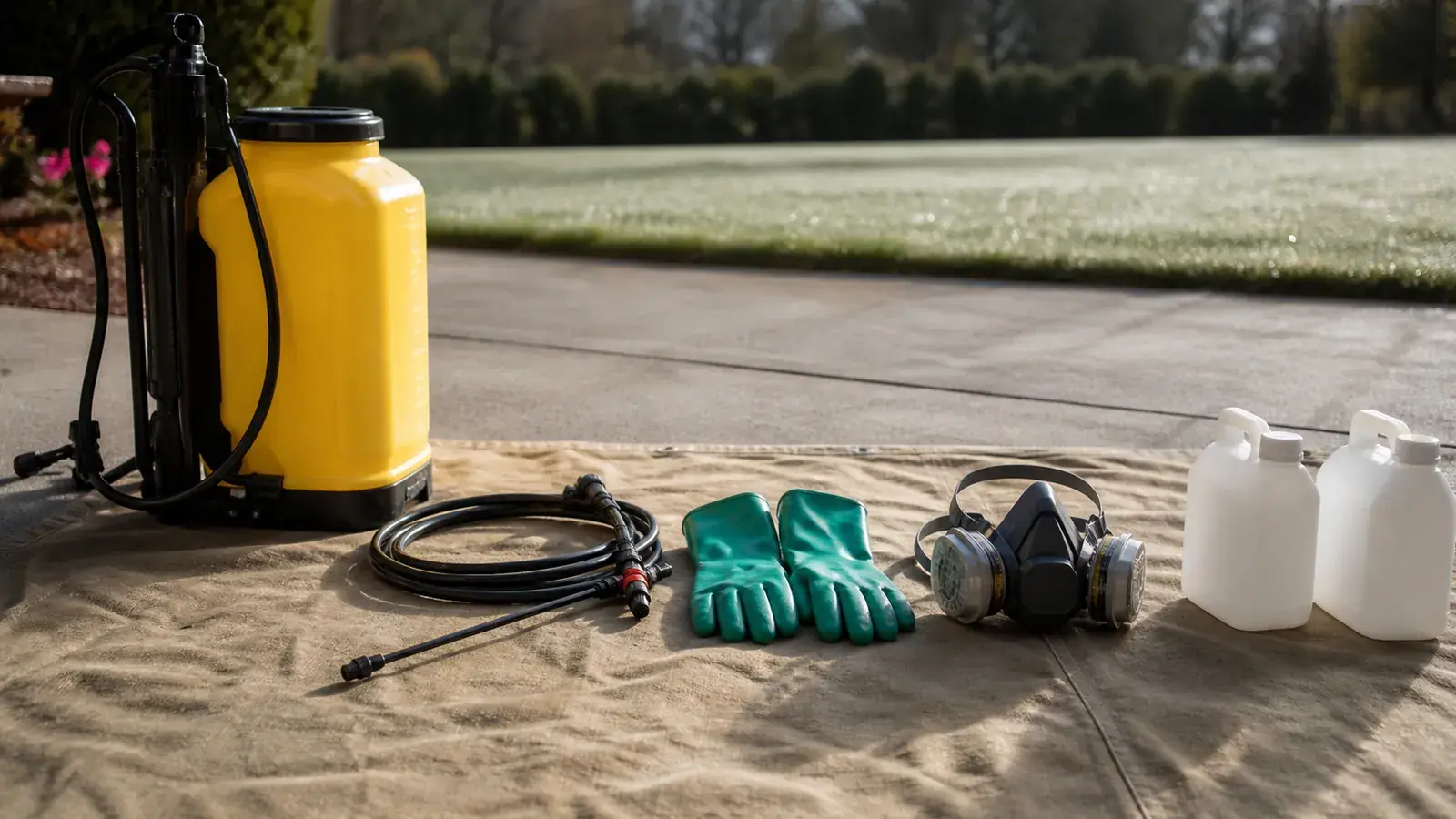
The federal baseline. EPA states that anyone who applies or supervises the application of restricted-use pesticides must be certified in accordance with federal standards and applicable state, tribal, or territorial rules. Certification itself is run by state and tribal authorities, and many states go further than the federal floor, requiring certification for all commercial applicators — not only those handling restricted-use products. Status: Verified, July 20, 2026. What this baseline does not supply is your state's exact category, business-license rule, local registration, fee, or insurance requirement — those come only from your state's own current sources.
A verified state example: California. California's Department of Pesticide Regulation licenses professional applicators and pest-control businesses, and its current packet shows how detailed one state's rules can get. A for-hire maintenance gardener who performs pest control only occasionally, as part of a gardening business, needs the Maintenance Gardener Pest Control Business License; a business whose primary purpose is pest control needs the separate Pest Control Business License route instead. The packet also requires a qualified applicator at each business location, county registration before work begins, records and use reports, and restricted-material permits where applicable. Status: Verified with limitation, July 20, 2026 — exact work classification, exemptions, and county details must be confirmed with DPR and the county.
Financial responsibility is not the same as adequate insurance. California's packet offers several routes to prove financial responsibility for this license — insurance, a deposit, a bond, or self-insurance. If the insurance route is used, the certificate must comply with the cited regulation and include chemical bodily-injury and chemical property-damage coverage. For the maintenance gardener category the regulation sets those amounts at $5,000 bodily injury per person, $10,000 per occurrence, and $5,000 property damage — or a $5,000 certificate of deposit or surety bond, or a statement to the Director under penalty of perjury of personal financial ability to respond in damages (3 CCR §6524(c), verified August 5, 2026). The same regulation sets $100,000 per person, $300,000 per occurrence and $50,000 property damage, or a $75,000 deposit or bond, for an agricultural pest control business making ground-rig applications; DPR's own Pest Control Business packet repeats the $75,000 deposit and bond figures. These are compliance thresholds for a license route, not an editorial recommendation of adequate limits, and not proof that a specific claim would be covered: a single drift claim on a neighbouring property can exceed the maintenance-gardener figures many times over. The bond and deposit options here are jurisdiction-specific compliance instruments — not interchangeable with a typical contractor's bond; license and permit bond basics explains the general category.
Every other state: check your own authority. Do not infer your state's applicator, business-license, registration, or financial-responsibility rules from California's, from a neighboring state's, or from this page. EPA's certification page links to the state and tribal certifying authorities; that official path — not a summary — is the verification step.
The insurance question that follows. Once the licensing question is settled, put the coverage question to the carrier or licensed producer in writing: does the proposed policy, on its actual form and endorsements, cover the exact chemical activity you perform — these products, these use classes, these application methods, in these states — and how does it treat drift and pollution? Do not assume a generic landscaping policy covers chemical work, and do not assume it excludes it either. Policy wording, endorsements, exclusions, limits, and facts control, and endorsement names and availability differ by carrier.
The state layer: what changes where you work
Coverage of this section, stated plainly: seven states are verified below in detail for pesticide authority and the landscape-license question, and ten states are verified in the workers-compensation table that follows. Every other state and territory is routed to its own governing authority by the directories named beneath. No row here is inferred from another state, and a cell that says "not verified in this pass" means exactly that — never "no requirement."
Three state-level questions decide most of what a landscaping business must hold, and they are answered by three different agencies: who governs chemical application, whether landscape work itself needs a state license, and when workers compensation becomes mandatory. The workers-compensation answer is the one most likely to be wrong in a landscaper's head, so it gets its own table first.
When workers compensation starts, and who can be left off
Ten states verified against their governing agencies or statutes on August 5, 2026. Employee counts, owner elections, and the treatment of family members and seasonal workers all vary by state, and no state's rule predicts another's. Confirm your own position with the agency named in the final column before you hire. Deeper state-by-state detail on the workers-compensation requirement itself lives at workers comp requirements by state.
| State | Coverage required when | Owners, officers, and members | Market | Governing source |
|---|---|---|---|---|
| California | One or more employees, including family members | Sole proprietors are not employees and may elect coverage; officers and directors owning all stock may exclude themselves | Private | DIR Division of Workers' Compensation |
| Texas | Not required for most private employers; required for employers working under a government contract | Non-subscribers must file an annual notice with DWC, post notice, and tell each new hire in writing | Private, or lawful non-subscription | Texas Department of Insurance, DWC |
| Florida | Construction industry: one or more employees. Non-construction: four or more. Agriculture: six regular or twelve seasonal | Corporate officers and LLC members count as employees; construction exemptions are limited and must be filed | Private | Florida DFS, Division of Workers' Compensation |
| New York | All employees, including part-time workers and family members | Narrow exemption only: a one-owner business, partnership, or one- or two-person corporation with no employees, volunteers or subcontractors of any kind | Private, plus the New York State Insurance Fund | NYS Workers' Compensation Board |
| North Carolina | Three or more employees | Sole proprietors, partners and LLC members are not automatically counted; corporate officers count even when they exclude themselves | Private | NC Industrial Commission |
| Georgia | Three or more persons, full-time, part-time or seasonal | Up to five officers or LLC members may exempt themselves, but the exemptions do not reduce the count; sole proprietors and partners may elect in | Private | Georgia State Board of Workers' Compensation |
| Pennsylvania | One or more employees, including part-time workers and family members | Sole proprietors and general partners with no other employees, and LLCs whose only workers are members, sit outside the requirement; executive officers need a granted exclusion | Private | PA Department of Labor & Industry |
| Arizona | Employers with employees | Sole proprietors are not automatically covered and may waive under §23-961(N); officers and LLC members are covered unless they file a written rejection | Private | A.R.S. §23-961 |
| Ohio | One or more employees | Elective for sole proprietors, partners, LLCs acting as either, family-farm corporate officers, and an individual incorporated with no employees | State fund only (BWC) | Ohio BWC elective-coverage form U-3S |
| Washington | Employers with employees; premium is reported on hours worked rather than payroll | Sole proprietors, partners and exempt corporate officers are not required to cover themselves and may apply for elective coverage | State fund only (L&I) | Washington L&I |
Four things in that table catch landscaping businesses specifically.
Florida can move your threshold from four employees to one, because of a class code. Florida's compliance rule adopts a list of construction-industry classification codes, and states that an employer is engaged in the construction industry when any portion of its operations is described by one of them. Code 0042, Landscape Gardening and Drivers, is on that list; code 9102, Lawn Maintenance, is not (Fla. Admin. Code 69L-6.021, verified August 5, 2026). The practical effect for a Florida landscaper is that a pure mowing-and-maintenance business is a non-construction employer at the four-employee threshold, while adding installation work can put the same business into the construction industry at one employee. Confirm your own classification and threshold with the Division before you hire, and read class codes and what they do to your premium alongside this.
A state exemption form is not a substitute for a sub's certificate. New York's CE-200 and Georgia's WC-10 are both addressed above in the audit section, and both states say in writing that the form does not do what contractors routinely assume it does.
Opting out is not the same as being exempt. Texas is the outlier: coverage is optional for most private employers, but an employer that opts out becomes a non-subscriber with its own duties — an annual filing with DWC, a posted notice, and written notice to every new hire — and loses the liability protection subscribers get. A government mowing or grounds contract removes the option entirely.
Two state-fund states are on this list. Ohio and Washington appear in the table as state-fund-only markets, which changes what you can buy and what is missing from it; that is covered in build the coverage stack.
California
- Pesticide and herbicide work: the Department of Pesticide Regulation licenses applicators and pest control businesses. A maintenance gardener who applies pesticides incidentally takes a different license route from a business whose primary purpose is pest control, and county registration comes before work begins.
- The state license question for landscape work itself: a Contractors State License Board license is required once a project's combined labor and materials reach $1,000. Below that figure the exemption also requires that no building permit is needed and that you employ no one on the job (AB 2622, Business and Professions Code §7048, effective January 1, 2025 — CSLB bulletin #24-07).
- Workers compensation: one or more employees, including family members. Private market. See the table above.
Texas
- Pesticide and herbicide work: the Texas Department of Agriculture states that applying pesticides to lawns, trees and ornamentals for hire requires a TDA license in the 3A category or a Structural Pest Control Service license, and that applicators who apply only fertilizer are licensed by neither. TDA's agricultural program licenses applicators using restricted-use and state-limited-use pesticides and regulated herbicides, so confirm with TDA which program covers the products you actually apply.
- The state license question for landscape work itself: not verified in this pass for landscape maintenance itself; irrigation and tree work are licensed separately in Texas — confirm both before quoting that work.
- Workers compensation: optional for most private employers, with non-subscriber duties if you opt out, and mandatory on government contracts. Private market. See the table above.
Florida
- Pesticide and herbicide work: the Department of Agriculture and Consumer Services states that the Limited Commercial Landscape Maintenance certification permits pesticide applications to ornamental plants and plant beds only — not to any turf area — and does not allow the holder to supervise employees under it or to operate a pest control business. The same page states that all commercial fertilizer applicators must be certified to apply fertilizer to commercial or residential turf or ornamental areas, with Green Industry Best Management Practices training required before the Limited Urban Commercial Fertilizer Applicator certification is issued. A Florida crew that only spreads fertilizer still needs a credential.
- The state license question for landscape work itself: not verified in this pass; confirm with FDACS and the county or municipality where you work.
- Workers compensation: one employee if any portion of your operations is a listed construction classification, four otherwise. Private market. See the table above and the Florida note beneath it.
New York
- Pesticide and herbicide work: the Department of Environmental Conservation certifies commercial applicators under 6 NYCRR Part 325, and a business offering pesticide application services for hire registers separately as a pesticide business. Separately, and more consequentially for landscape work, ECL 33-1301(13) — added by the Birds and Bees Protection Act — prohibits treating outdoor ornamental plants and turf with products containing clothianidin or dinotefuran from December 31, 2024, and extends that prohibition to imidacloprid, thiamethoxam and acetamiprid from December 31, 2026, outside agricultural production. Limited exemptions remain for invasive-species control on woody plants and for applications under a DEC written order, and applicators working under those exemptions must take a DEC-approved neonicotinoid course annually and keep the record for three years. Status: Verified with limitation, August 5, 2026 — confirm the current product list, exemptions and effective dates with DEC before buying inventory for a season.
- The state license question for landscape work itself: not verified in this pass; New York City and several counties run their own contractor registration schemes — confirm locally.
- Workers compensation: all employees, including part-time workers and family members, with only a narrow no-employee exemption. Private market plus the state fund. See the table above.
North Carolina
- Pesticide and herbicide work: the Department of Agriculture and Consumer Services requires a license for anyone applying pesticides other than by air for compensation on someone else's property under the North Carolina Pesticide Law of 1971 — any pesticide, not only restricted-use products.
- The state license question for landscape work itself: North Carolina licenses landscape contracting through a separate state board; not verified in this pass — confirm with that board before contracting.
- Workers compensation: three or more employees, with corporate officers counted even when excluded. Private market. See the table above.
Arizona
- Pesticide and herbicide work: the Department of Agriculture requires a business license of anyone engaging in, offering, advertising, soliciting or performing pest management, including the application of pesticides and the making of bids for it, and applicants must show proof of financial security.
- The state license question for landscape work itself: a Registrar of Contractors license is generally required when labor and materials exceed $1,000 or a permit is required (ARS §32-1121). A person performing lawn, garden, shrub and tree maintenance only is exempt from ROC licensure and must state "not a licensed contractor" in any advertisement (Arizona Commerce Authority checklist).
- Workers compensation: required where you have employees, with owner elections under A.R.S. §23-961. Private market. See the table above.
Washington
- Pesticide and herbicide work: the Department of Agriculture requires a landscape company applying pesticides to customers' properties to hold a Commercial Applicator license — including part-time operators — and to keep proof of financial coverage on record or face license suspension.
- The state license question for landscape work itself: not verified in this pass; Washington registers contractors through the Department of Labor & Industries — confirm the scope that applies to installation, irrigation and hardscape work before quoting it.
- Workers compensation: required where you have employees, bought from L&I, with premium reported on hours worked. State fund only. See the table above.
The federal floor is only a floor: North Carolina licenses application of any pesticide for compensation, and Florida's limited landscape certification stops at the edge of the lawn. A rule you learned in one state predicts nothing in the next. Washington makes the same point from the other direction: the license follows the activity, so a part-time operator spraying a few customer lawns needs the same commercial applicator license as a full-time one. The chemical authority and the contracting authority are also different agencies with different triggers, and Arizona shows why that matters — the same operator can be exempt from contractor licensure as a maintenance gardener and still need a pest management business license with proof of financial security the moment they bid a spray job.
Every other state and territory. Three official directories name the agency for every state, and they are the verification path for any jurisdiction not covered above. Find your pesticide authority in EPA's directory of state and territorial pesticide agencies, which names the agency for every state, territory and the District of Columbia. Find your workers compensation agency in the U.S. Department of Labor's directory of state workers' compensation officials. Find your insurance regulator — the authority on cancellation, non-renewal and admitted-carrier questions — in the NAIC's directory of state insurance departments. For contractor licensing, the authority is your state's contractor licensing board where one exists and your city or county building department where one does not — and in several states, as the blocks above show, landscape maintenance and landscape construction are treated differently. Four states run their own workers compensation fund instead of a private market, which changes what you can buy and what you are missing; that is covered next.
Build the coverage stack around your actual operations
The categories below are summarized from general sources including the SBA's business-insurance guide, from the coverage-form and rating sources cited elsewhere on this page, and from the exclusions table above. Coverage boundaries reflect common form treatment; exact wording varies by carrier and form and is not verified against any specific policy here. Every card below carries the same six fields so you can compare them against each other and against a quote.
Category-level shopping and deeper explanation live on the coverage hubs — general liability insurance and workers compensation insurance. This page's job is the landscaping application of each: make sure every service, chemical activity, and elevated exposure is disclosed and listed, because an operation the underwriter never saw is the classic dispute.
General liability
- What it does: addresses the most common third-party landscaping questions — a non-employee alleging bodily injury or property damage arising from your operations, including completed operations after the job.
- What it does not cover: your own property; your own employees; damage to your own work; damage to property in your care, custody or control; pollution, which is what decides chemical claims; liability arising from owned autos.
- How it is rated: commonly on projected revenue or payroll for the landscaping classification, reconciled at audit.
- Typical limit structure: a per-occurrence limit and a larger annual aggregate — the two halves of the "$1M/$2M" pattern — over a deductible.
- Endorsements clients commonly demand: additional insured for ongoing and completed operations, primary and noncontributory, waiver of subrogation, and a chemical or applicator endorsement where you spray.
- Confirm in the quote: which form and edition, whether every service on your list is scheduled, how completed operations applies to hardscape and irrigation, and what the care-custody-and-control exclusion does to a damaged driveway or irrigation line.
Tools and equipment (inland marine)
- What it does: covers your mowers, blowers, trimmers, sprayers and compact equipment, which spend their working lives in transit and on other people's property.
- What it does not cover: liability to other people; wear, tear and mechanical breakdown; theft from an unattended or unlocked vehicle on many forms; equipment left on a jobsite overnight on many forms; items above a scheduled value. Property that stays at a fixed premises belongs on a property policy or BOP instead — the dividing line is where the item normally lives, so a mower stolen from your locked yard and a mower stolen from the trailer at a job are two different claims on two different policies.
- How it is rated: on the scheduled or blanket value of the equipment, adjusted for deductible, storage security and prior theft losses.
- Typical limit structure: a blanket limit with a per-item sublimit, often with a separate small-tools limit and its own deductible.
- Endorsements clients commonly demand: rarely required directly, but a contract requiring a waiver of subrogation across all policies has to be endorsed here too.
- Confirm in the quote: transit and overnight-jobsite treatment, whether towed equipment sits here or on the auto policy, the per-item sublimit, and how to add equipment mid-term.
Commercial auto, and hired and non-owned auto
- What it does: covers business vehicle liability and physical damage for owned trucks and trailers; hired and non-owned auto addresses vehicles you rent or that employees own and use for your work.
- What it does not cover: a personal auto policy's business-use gap is not fixed by hired and non-owned auto alone, and owned-vehicle liability and hired-and-non-owned are separate coverages. Cargo and towed equipment are commonly handled elsewhere.
- How it is rated: on vehicles, their use and radius, driver records, and limits.
- Typical limit structure: a combined single limit per accident, with physical-damage deductibles per vehicle.
- Endorsements clients commonly demand: additional insured and waiver of subrogation on the auto policy, which contracts often require and owners often forget to buy.
- Confirm in the quote: is hired and non-owned included, and does it respond when an employee drives their own truck to pick up materials; are trailers scheduled or blanket; who is an excluded driver; how is winter plowing treated.
Workers compensation
- What it does: pays medical and wage benefits to an injured employee under state law, and is the reason a landscaping crew is insurable at all.
- What it does not cover: it is not general liability and does not respond to third-party claims; it does not cover a genuinely independent contractor, though state rules and facts — not a 1099 — decide who is one.
- How it is rated: on payroll within an assigned classification, reconciled at audit; Washington reports on hours worked instead. See class codes and what they do to your premium.
- Typical limit structure: statutory benefits, with separate employer's liability limits alongside.
- Endorsements clients commonly demand: a waiver of subrogation in favor of the client, which is commonly required in commercial grounds contracts.
- Confirm in the quote: what classification was assigned and what operations it includes, whether the owner is included or excluded, what the audit basis is, and how payments to uninsured subcontractors are treated.
Employer's liability, and stop-gap in state-fund states
- What it does: responds when an injured worker sues you rather than claiming benefits — the half of workers compensation that is easiest to lose without noticing.
- What it does not cover: it is not a substitute for statutory benefits, and it carries its own separate limits rather than sharing the workers-compensation limit.
- How it is rated: normally as part of the workers-compensation policy, or as an endorsement priced on the general liability policy where a state fund does not provide it.
- Typical limit structure: three separate limits — bodily injury by accident, by disease per employee, and by disease policy limit.
- Endorsements clients commonly demand: the stop-gap endorsement itself, where a contract requires employer's liability limits in a state-fund state.
- Confirm in the quote: whether employer's liability is included at all, at what limits, and — in a state-fund state — whether stop-gap has been added to your general liability policy by name.
Four states run their own fund, and one coverage goes missing when they do. In North Dakota, Ohio, Washington and Wyoming — and in Puerto Rico and the U.S. Virgin Islands — workers compensation is bought from the state's own fund rather than from a private carrier, and the agencies are listed in the U.S. Department of Labor's directory of state workers' compensation officials. That changes two things for a landscaping business. State-fund policies commonly provide the benefits half of workers compensation but not employer's liability — the half that responds when an injured worker sues you rather than claiming benefits — and the gap is normally closed by a stop-gap employer's-liability endorsement added to your general liability policy, which you have to ask for by name. And a private policy written for other states does not simply extend into these four; if you cross a line to work, you register with that state's fund separately. Confirm your own position with the fund named in the DOL directory and with a licensed producer in that state before you assume a private quote covers you. Status: market and underwriting condition — verify with the fund and the carrier, verified August 5, 2026.
Commercial property or a business owner's policy
- What it does: covers your own premises and contents — a shop, yard, office, or nursery stock — and in a BOP bundles that with general liability.
- What it does not cover: equipment that normally travels, which belongs on the inland marine schedule; flood and earth movement are commonly excluded; outdoor property, nursery stock and trees commonly carry sublimits well below their real value.
- How it is rated: on building and contents values, construction, protection and location.
- Typical limit structure: separate building and contents limits with a deductible, plus named sublimits for outdoor property.
- Endorsements clients commonly demand: a landlord named as additional insured or loss payee under a lease.
- Confirm in the quote: the outdoor-property and nursery-stock sublimits, whether stored equipment is covered here or on inland marine, and whether business interruption is included.
Professional liability (errors and omissions)
- What it does: responds to claims alleging negligent landscape design, specification or advice that you were paid for.
- What it does not cover: bodily injury or property damage arising from your physical operations, which is general liability's job; it is not a warranty on plant survival or workmanship.
- How it is rated: on design or consulting revenue, services offered, and prior claims.
- Typical limit structure: claims-made, with a per-claim and aggregate limit, a retention, and a retroactive date that matters more than most buyers realise.
- Endorsements clients commonly demand: it is usually the contract itself that demands the policy, at a stated limit, on design-build work.
- Confirm in the quote: the retroactive date, whether the policy is claims-made, and whether design-build work is inside the definition of professional services.
Umbrella or excess liability
- What it does: adds limits above scheduled underlying policies when a contract demands more than you carry.
- What it does not cover: gaps. It generally follows the underlying form, so a gap below is usually a gap above — an umbrella over a policy that excludes chemical work does not cover chemical work.
- How it is rated: on the underlying exposures and limits, and on the underlying policies' terms.
- Typical limit structure: a single limit above scheduled underlying policies, sometimes with a self-insured retention over unscheduled exposures.
- Endorsements clients commonly demand: additional insured following form, where the contract requires the endorsement at the full required limit rather than only on the primary.
- Confirm in the quote: which underlying policies are scheduled, whether the auto policy is among them, and whether the umbrella follows form on the endorsements the contract requires.
Chemical or applicator endorsement
- What it does: restores, if at all, the pesticide and herbicide coverage the pollution exclusion removes — including, on some forms, drift and overspray.
- What it does not cover: government permission. It does not certify an applicator, license a business, or satisfy a state financial-responsibility requirement. Availability and wording differ sharply by carrier, and some markets decline chemical work outright.
- How it is rated: on the products, use classes, methods, acreage and locations you disclose, and on prior incidents.
- Typical limit structure: commonly a sublimit inside the general liability policy rather than a full limit, and sometimes a separate deductible.
- Endorsements clients commonly demand: a property manager may require the chemical coverage by name in the contract, and may require it to appear on the certificate.
- Confirm in the quote: the endorsement's form number and edition, whether drift and overspray are inside it, the sublimit, and whether every product you apply is eligible.
Specialty operations change everything upstream. Tree work and line clearance, work at height, excavation and grading, retaining walls and hardscape, irrigation installation, snow and ice work, chemical application, and subcontracted crews can each change eligibility, exclusions, classification, price, or licensing. OSHA's landscape and horticultural services page is a useful operations inventory — it catalogs the trade's real activities and hazards, from equipment and falls to chemicals, heat, noise, and electrical exposure — but it is an occupational-safety source: use it to describe your operations completely, never to infer that any insurance policy covers, excludes, or prices a hazard.
What landscaping insurance costs and what the number means
Price evidence verified as of July 20, 2026; each figure carries its own source date below. Cover My Trade is an independent editorial publisher — not an insurer, agency, broker, or advisor — and none of the figures below is a quote.
What you pay is driven by your service mix and chemical application, tree and height exposure, state, revenue, payroll and workers, subcontractor use, project values, vehicles and trailers, equipment values, premises, claims history, limits, deductibles, endorsements, and — for workers compensation — the classification you are assigned and your experience rating. Two landscaping businesses with the same revenue can carry very different premiums because they differ on the drivers that matter, which is why a single "landscaping insurance cost" number cannot exist honestly.
Published numbers come in different evidence types, and the type decides what a number can support:
| Evidence type | What it is | What it can support | What it cannot support |
|---|---|---|---|
| Live bindable quote | A dated, purchasable price for one fully documented business profile | "This profile was quoted this price on this date" | A universal price or guaranteed availability |
| Indication | A non-bindable estimate with underwriting conditions outstanding | A dated ballpark for the stated profile | A quote, average, or promise |
| Provider-published median | The midpoint of one provider's own customer set | That provider's disclosed customer set | A market average or benchmark |
| Provider starting estimate | A "from" figure with a disclosed method, often a low percentile of sold policies | The provider's own published floor | A typical price, or comparison to a live quote |
| Duration-based range | Prices for hourly, monthly, or per-job policies | That provider's sold-policy range for those durations | Direct comparison to annual figures |
| CMT controlled sample | A dated quote or indication with every profile, coverage, fee, carrier, and verification field documented | A dated sample for the disclosed profile | Any average or index claim until the dataset gate is met |
Here is the current evidence for landscaping, labeled exactly:
| Source and type | Published figure | Documented basis | Limitations and permitted use |
|---|---|---|---|
| Insureon — provider-published median | $51/month general liability ($610/year); $1M/$2M limits; $500 deductible | Median of policies purchased by Insureon's landscaping customers; page updated February 24, 2026 | No state, operations, carrier, form, or fee disclosure. Source conflict: the page says average in prose while its methodology note says medians. We report the median. Label: provider-published median — not a market average or quote |
| Simply Business — provider starting estimate | From $29.17/month; $1M–$2M limits | 10th percentile of relevant policies sold July–December 2025, per its page's footnote; final price and payment vary and may include a down payment | No complete risk profile; pesticide eligibility not addressed. Label: provider starting estimate only |
| Thimble — sold-policy duration range | $8/hour to $43/month | Based on policies sold, per its page; varies by location, limits, team size, and coverage duration | Hourly and monthly units are not comparable to each other or to annual figures; no full profile or chemical-application statement |
Cover My Trade has not yet published its own sample for this trade. No complete live quote or indication carrying every required field — profile, coverage, limits, deductible, fees, carrier, and verification date — was available in this research pass, and a sample appears here only when one meets the site's premium-data standard. Nothing on this page is a Cover My Trade average, benchmark, or index.
Three rules keep these numbers honest. A provider-published median, a starting estimate, and an hourly range are three different kinds of evidence; averaging them produces a number that describes no real policy. Monthly figures with different bases — a median, a tenth-percentile floor, a flexible-duration price — cannot be ranked against each other as if they were competing quotes for your business. And no monthly figure is complete without knowing the installment fees, down payment, and taxes behind it, which none of these public figures fully discloses.
What actually moves your number: a worked example
The figures above belong to three providers' own customer sets. This example belongs to nobody's — it is a direction model, not a price. It takes one documented profile and changes one driver at a time, so you can see which decisions move a landscaping premium and why.
The base profile. Solo owner, California, landscape maintenance only — mowing, trimming, bed work, seasonal planting. No chemical application. No employees. One truck and a trailer, owner-driven. About $140,000 of annual revenue. Residential clients, no written insurance requirements. General liability at $1,000,000 per occurrence and $2,000,000 aggregate, $500 deductible, plus a tools-and-equipment schedule. No claims.
| Change one thing | What moves, and in which direction | Why |
|---|---|---|
| Add two employees with payroll | Adds a workers compensation policy rated on payroll at the assigned landscaping classification, and can change the general liability rating basis | Workers compensation is a separate policy governed by state law; payroll becomes an audited exposure, and both premiums reconcile at audit |
| Add occasional herbicide application | Changes eligibility before it changes price, and adds licensing and certification cost outside insurance | The pollution exclusion decides the coverage question, so the carrier must confirm the activity and the endorsement; some markets decline chemical work outright |
| Add tree work at height or line clearance | Commonly changes classification, and can move the risk out of the standard market entirely | Height and tree removal carry their own exclusions and appetite limits; a landscaping class rarely includes them |
| Add a written contract requiring $2M per occurrence, additional insured, primary and noncontributory, and a waiver | Adds endorsement premium and can require an umbrella over the underlying limits | The endorsements are purchased separately, and umbrella pricing follows the underlying form |
| Add three uninsured subcontractors for a spring install | Adds premium at audit rather than at binding | Payments to subs who cannot produce coverage are commonly charged as your payroll |
A planning band, and what it is not. Composed only from the dated figures already on this page, and for general liability alone, the public evidence for a small landscaping business sits between roughly $29 and $51 a month — the lower end being Simply Business's disclosed tenth-percentile starting estimate for policies sold July–December 2025, the upper being Insureon's published median for its own landscaping customers at $1M/$2M limits with a $500 deductible, page updated February 24, 2026. Read that band with four limits attached. It is composed from two providers' differently-based published figures, so it is not a market range, not an average, and not a quote. It describes general liability only, and excludes workers compensation, commercial auto, tools and equipment, property, and every endorsement a contract might demand — the lines that usually cost a crewed landscaping business more than its general liability does. It carries no state, no operations detail, and no fee or down-payment disclosure. And it describes businesses that a standard market was willing to write: no public figure on this page describes a landscaping business that applies chemicals or works at height, because for those operations the question is eligibility before it is price.
The single driver that moves the spread most for this trade is not revenue — it is eligibility. Chemical application and elevated tree work decide whether a standard market will write you at all, and a decline or a specialty placement changes the number far more than another $50,000 of mowing revenue does. That is why the requirement questions on this page come before the price questions.
Compare quote paths by operational fit, not headline price
Provider facts below were read from each provider's current public pages on July 20, 2026 and are rechecked on publication day. Where a public page is silent, the field says so — silence is never interpreted as coverage, exclusion, or availability.
Who actually issues the policy: provider roles defined
The role behind a quote path changes who bears your risk, who processes endorsements and certificates, and where your data goes.
| Role | Who issues and bears the policy | What the role changes for you |
|---|---|---|
| Direct carrier | The carrier itself | One company's appetite, forms, claims handling; endorsements and COIs through it or its agents |
| MGA / program administrator | Administers underwriting for one or more carriers that bear the risk | Ask which carrier issues the policy and who handles endorsements, COIs, and claims |
| Broker / agency | A licensed producer places you with carriers, which bear the risk | One application can return several quotes; the producer typically services COIs and endorsements; ask about fees |
| Comparison marketplace | Routes your details to producers or carriers; may itself hold an agency license | Ask who becomes your producer of record, who issues proof, and how your data and leads are routed |
Where an option's role is not supported by its own current first-party documentation, this site labels it "Role not verified" rather than inferring it.
The three options below have current, first-party landscaping pages that support the facts shown — and only those facts. They are listed alphabetically; each is an option to quote, not an endorsement, and eligibility for your actual operations remains underwriting-dependent.
| Option and role | What its current public page shows | Pesticide / herbicide | Price evidence (label and date) | Confirm before relying on it |
|---|---|---|---|---|
| Insureon — marketplace / agency path, per its own site (Jul 20, 2026) | A full landscaping coverage-and-cost menu with customer medians and cost drivers | Its page states a pesticide/herbicide applicator endorsement can be added; the carrier, form, states, and eligible operations are not identified | Insureon-published median: $51/month GL, $1M/$2M, $500 deductible (page updated Feb 24, 2026) | Exact carrier, form, and state availability; chemical, drift, and pollution wording; fees; COI and endorsement workflow |
| Simply Business — multi-quote licensed producer, per its own site (Jul 20, 2026) | A current landscaping page with a multiple-quote workflow and a transparent price-methodology footnote | Not confirmed on the reviewed public page — verify in the quote | Provider starting estimate: from $29.17/month, $1M–$2M limits (10th percentile of policies sold Jul–Dec 2025) | Eligible activities and states; carriers and forms; pesticide application; fees and down payment; proof and endorsement workflow |
| Thimble — licensed insurance producer with job, month, and year policy durations, per its site and appetite guide (Jul 20, 2026) | Lawn care, tree trimming/pruning, and snow removal listed; certificate workflow described for its own policies; availability varies by state and class | Not confirmed on the reviewed public page — verify in the quote | Sold-policy range: $8/hour to $43/month, varying by location, limits, team size, and duration | Exact activity and state appetite; chemical application; exclusions; policy duration fit; equipment and auto availability |
Not ideal for — stated from the documented gate that failed, and nothing more.
- Insureon is not ideal for an operator who needs the carrier, form, and state availability settled before applying: its page states an applicator endorsement can be added, but the carrier, form, eligible operations, and states behind it were not identified on the reviewed public page as of July 20, 2026.
- Simply Business is not ideal for any operation applying pesticides or herbicides until the activity is confirmed in writing: chemical application was not confirmed on the reviewed public page as of July 20, 2026.
- Thimble is not ideal for the same reason, and additionally for an operator who needs annual-term pricing directly comparable to the other two: its published figures are hourly and monthly sold-policy ranges, and availability varies by state and class as of July 20, 2026.
One field is missing from all three by construction: none of the reviewed pages identifies whether a placement will be with an admitted or a surplus-lines carrier, or that carrier's financial-strength rating, because both are carrier-level facts settled inside the quote rather than on a marketplace or producer page. Ask every option for both before you bind, and expect the answer to change by state and by operation.
Use this table as a question generator, not a ranking. The decisive fields for many landscapers — chemical-application eligibility, exact state appetite, endorsement forms and fees — are precisely the ones public pages leave open, so the same written questions go to every option, and the answers, not the headlines, drive the choice.
How to handle a COI or additional-insured request
General sequence verified against the sources on this page as of July 20, 2026; exact endorsement wording and availability are carrier-specific.
Certificate requests feel urgent, but the legitimate sequence is short and fixed. First, collect the request precisely: the requester's legal name and address, the required policy types and limits, the project and location, dates, the certificate holder's details, and the exact endorsement wording demanded. Second, separate the asks — a certificate holder is not an additional insured, and additional-insured status, a waiver of subrogation, primary and noncontributory wording, chemical-liability language, or a cancellation-notice term each generally require the appropriate endorsement or policy provision, not just a name typed on a certificate. Third, bind valid coverage that actually matches the request, and have the carrier or its authorized producer issue the certificate and process the endorsements. The general mechanics — what each field and endorsement means — live at how a certificate of insurance works; this page's point is the landscaping application.
| Term in your contract | What it actually means, in one line |
|---|---|
| Certificate of insurance | Evidence that a policy existed on the date the certificate was issued; it changes nothing about the policy |
| Certificate holder | The party who receives the paperwork — the status carries no rights under the policy by itself |
| Additional insured | An endorsement extending defined protections of your policy to them; the form number and its edition are what to confirm, and ongoing operations and completed operations are commonly two different forms (CG 20 10 and CG 20 37) |
| Primary and noncontributory | Your policy pays first and does not ask theirs to contribute |
| Waiver of subrogation | Your insurer gives up its right to recover from that party after paying a claim |
| Per occurrence and aggregate | The most the policy pays for one claim, and the most it pays for the whole policy term — the two halves of the "$1M/$2M" pattern |
| Completed operations | Claims arising after your work is finished, as distinct from claims arising while you are on site |
Two cautions. A licensing authority may demand a particular certificate form, an exact statement, or an alternative financial-responsibility instrument — California's DPR packet is a live example — so a generic certificate may not satisfy a specific government submission. And never promise a client that requested wording is available or sufficient before the carrier confirms it; unusual endorsements, government forms, chemical-liability wording, and contract conflicts are exactly the items to escalate to the carrier, producer, authority, or a qualified professional.
Prepare the quote accurately and know when to stop
The inputs below are the quote application, the underwriting file, and — as covered in the situation router below — your per-provider scorecard. Accuracy is not paperwork hygiene: understating chemical use, tree work, subcontractors, project scope, vehicles, or hazardous activities can undermine eligibility and make every number you receive useless.
| Input group | What to have ready |
|---|---|
| Business identity | Legal name and entity, DBA, address, states and counties served, years in business, prior insurance and any cancellations |
| Operations | Every service with its share of work: mowing, maintenance, installation, pesticide/herbicide, tree work and height, irrigation, grading and excavation, hardscape and retaining walls, snow and ice, design, nursery or storage, subcontracted work |
| Pesticide specifics | Products and use classes, restricted-use status, application methods, acreage and locations, drift controls, storage and transport, applicator certificates, business license, county registrations and permits, records, prior incidents |
| Financial and workforce | Annual revenue, payroll, employee count, owner inclusion or exclusion, subcontractor cost, subs' certificates and agreements, states where workers work |
| Vehicles, trailers, tools, property | Owned, non-owned, and hired vehicles and their use; drivers; trailers; mower, equipment, and sprayer values; tool storage; shop, yard, or office exposures |
| Losses and controls | Claims and loss runs, safety and training practices, pesticide handling procedures, contracts and waivers, client key or property access, prior declinations |
| Requested terms | Coverage types, limits, deductibles, chemical or applicator endorsement, additional insured, primary/noncontributory, waiver of subrogation, project and location, certificate holder, deadline |
Class codes and what they do to your premium
Rating-bureau facts verified August 5, 2026. Classification systems differ by state: NCCI administers the system in most states, while California, New York and several others use their own rating bureaus. Confirm the phraseology that applies to you with the bureau for your state, not with a summary.
Ask what classification you were put in, because the code decides the rate applied to your payroll — and, as Florida shows above, it can decide whether you are a construction employer at all. For landscaping, three codes carry most of the work.
| Code | What it describes | What moves payroll into it |
|---|---|---|
| 9102 — Lawn Maintenance, Commercial or Domestic, and Drivers | Maintaining and servicing existing landscapes | Mowing, raking, fertilizer application, lawn spraying, thatching and aerating, and trimming shrubs or small trees from the ground; minor incidental planting stays here |
| 0042 — Landscape Gardening and Drivers | Installing new landscapes; treated as a construction code in some states | Laying out grounds, clearing, grading, seeding and sodding, and planting trees, shrubs and flowers; on-grade walkways, patios and dry-laid segmental retaining walls as part of a landscaping project |
| 0106 — Tree Pruning, Repairing or Trimming, All Operations to Completion and Drivers | Tree work, including work at height | Climbing, ladders and lifts; tree removal. Masonry garden walls are a different code again |
Three consequences follow, and they are the reason to ask.
The wrong code is the most common landscaping rating error, and it usually runs against you. NCCI's own classification-inspection research reports that where an inspection changed the governing code away from Code 0042, 73% of those employers were moved to Code 9102 — because the work they actually performed was better described as maintenance than as new landscape installation (NCCI, Top Reclassified Codes in 2022, published August 17, 2023, using 2020–2022 inspection data). A maintenance business sitting in the installation code is paying an installation rate.
Both codes can sit on one policy, but only if your records support it. NCCI states that Code 0042 and Code 9102 may be assigned to the same employer provided the employer maintains verifiable payroll records. Without those records, the split does not survive the audit and payroll is assigned to the higher-rated code — which is the same records problem that decides the subcontractor question above.
Ground crews on a tree job are not automatically landscape payroll. California's rating bureau has addressed this directly, stating that tree removal cannot be assigned to Classification 0042 regardless of whether the operations are performed from ground level (WCIRB, Tree Operations: How Classifications 0106 and 0042 Apply). If you add tree work, expect the classification question before the price question.
Add three questions to every quote: what classification did you assign, and what operations does it include?; if I run both maintenance and installation crews, what records do you need to split the payroll?; and, for workers compensation, is the owner included or excluded, and what is the audit basis? If a code is quoted to you, confirm what it covers with the carrier and with the rating bureau that applies in your state before you rely on it.
Know when to stop and get qualified help. Some questions are beyond self-service, and pushing through them creates the expensive mistakes. Stop and obtain licensed or legal guidance when your applicator or business-license classification is unclear; when permits or county registration requirements are ambiguous; when employee-versus-subcontractor status is contested; when a contract's indemnity or endorsement wording conflicts with what a carrier offers; when a carrier declines your operations; or when you need a coverage interpretation for an actual claim. And if something has already happened on a job, report it to your carrier's claims line within the notice period your policy requires, before you spend time working out whether you are covered — late notice can cost you a claim that the policy would otherwise have paid. Those are professional questions, and this page is editorial background, not advice.
Your situation, your first move
The rows below describe the documented characteristics to shortlist, not named vendors, because the decisive fit facts — chemical-application appetite and exact state availability — were not symmetrically verified across candidates in the current research pass; the comparison table above carries the named, verified public facts. Every route is an option to quote, never a promise of coverage, eligibility, or price.
| Your situation | First move | Shortlist move | Confirm in the quote |
|---|---|---|---|
| Solo, mowing and maintenance only, one state, no employees | List operations and equipment values from the checklist above | Quote GL plus a tools-and-equipment option through paths that list your actual services on their public application and publish the basis behind any advertised price | Are completed operations included? Is equipment covered in transit? What are the exact limits and deductible? What classification did you get? |
| Hiring your first employee | Confirm your own state's threshold and owner-election rule with the agency named in the workers compensation table before the first day of work | Shortlist paths that can quote general liability and workers compensation together and will state the audit basis in writing | Does the threshold count part-time, seasonal and family workers? Am I included or excluded as owner? Which classification applies to this employee's actual duties? Does hired and non-owned auto respond if they drive their own truck? |
| Crew with payroll, occasional herbicide application | Confirm the requirement first: state applicator and business-license authority, and your state's workers-comp rule | Shortlist only carriers or producers that will confirm the chemical activity, the endorsement, and drift and pollution treatment in writing, and that can quote general liability and workers compensation together with published payroll-audit terms | Which endorsement covers the chemical activity, and at what cost? How are drift and pollution treated? How are subcontractors treated at audit? What are the payroll-audit terms? |
| Commercial contracts with COI and additional-insured demands | Gather the written requirement — exact limits, wording, certificate holder | Quote paths that document additional-insured endorsement processing and certificate-issuance workflow before you bind, so the contract's wording can actually be delivered | Which additional-insured form and edition is used, and what does it cost? Is primary/noncontributory available? What is certificate turnaround after binding? What cancellation notice can be given? |
| Regular use of 1099 subcontractors through the season | Build the subcontractor file before the season: certificates, policy periods, signed agreements | Shortlist paths that will state in writing how they treat uninsured subcontractors at audit and what records they require | How are payments to uninsured subs treated at audit? Does my general liability policy restrict subcontracted work? What documentation closes the exposure, and by when? |
| Trucks, trailers and towed equipment; employees driving | Inventory every vehicle, trailer and driver, plus any personal vehicles used for business | Shortlist paths that quote commercial auto and hired and non-owned auto alongside general liability rather than treating vehicles as an afterthought | Is hired and non-owned auto included, and does it respond when an employee drives their own truck? Are trailers scheduled or blanket? Is towed equipment on the auto policy or the tools schedule? Who is excluded from driving? |
| Tree work at height, line clearance, or a market that has already declined you | Document heights, methods, equipment and training before you apply again | Expect a specialty or surplus-lines path through a licensed producer rather than a self-service quote; ask each producer which markets they have for elevated work | Is tree work inside the quoted classification or excluded? What height limits apply? Is the carrier admitted in your state, and what does that change if it fails? |
| Bidding public, municipal or prevailing-wage grounds work | Read the bid documents for insurance, bond and endorsement requirements before you price the job | Shortlist a licensed producer with surety access, because bid, performance and payment bonds are underwritten separately from insurance — see license and permit bond basics | What limits and endorsements do the bid documents require? Is a bond required, and of what kind? Does a wrap-up or owner-controlled program change what I must carry? Does the contract require workers compensation where my state would not? |
One scorecard for every option: reuse the quote-input checklist above as the per-provider card. Put the same rows to every path — operations, chemical specifics, workforce, vehicles, requested terms — and compare the written answers rather than the marketing pages.
After you bind: renewals, audits, and when a market says no
Binding is the middle of the job, not the end of it. What keeps a landscaping policy honest through the year is maintenance, and what changes the answer entirely is a market, a contract, or a claim.
Maintaining the policy. Report operations changes before they happen, not after a claim: adding chemical application, taking on tree work, buying a truck, hiring a first employee, and taking winter snow contracts each change what the policy was underwritten on. Refresh certificates for every client that requires one at renewal, and diarise every subcontractor certificate for its expiry rather than its issue date. Keep the audit file — payroll records, subcontractor certificates, loss runs — through the audit, which arrives after the term ends rather than with the renewal.
When the answer changes.
- No standard market will write your work. Tree work at height, line clearance, and some chemical operations sit outside standard appetite. The route is a licensed producer with surplus-lines access. An admitted carrier is licensed by your state and its policies are generally backed by the state guaranty fund if the insurer fails; a surplus-lines (non-admitted) carrier is not, and its forms are not subject to the same state form approval — which is how it can write risks the standard market declines. Ask which you are being offered, what the guaranty-fund position is, and how the form differs, and get the answers before you bind.
- The contract demands limits you cannot afford. There are two honest moves: negotiate the requirement with the client, or price an umbrella over lower underlying limits. Have the contract read before you sign it — an indemnity clause can obligate you far beyond what any policy you own will pay, and that is an attorney's question, not a producer's.
- Your loss history has changed the answer. Claims follow the business for years and show up as declinations, higher deductibles, or narrowed terms rather than as a single higher number. Ask a producer to market the account rather than re-quoting the same path.
- You are operating uninsured right now. The exposure is personal and immediate, and for the workers compensation piece many states add penalties and stop-work orders on top of the underlying liability. Verify your own state's rule with the agency in the DOL directory and bind before the next job, not after it.
- You were non-renewed mid-project. Notice periods for non-renewal and for mid-term cancellation are set by state law and your policy, and they are not the same period: cancellation for non-payment is typically far shorter than non-renewal notice, and some states also require notice when a carrier proposes to renew on materially worse terms. Treat the notice date as the start of your replacement timeline rather than the end of the current one. A non-renewal is generally not curable — it is the carrier declining to continue — while a cancellation for non-payment, or for an unreturned audit request, often is, inside a short window. Find your state's rule through the NAIC's directory of state insurance departments, call the producer the day the notice arrives, and tell the general contractor or property manager before their certificate-tracking service does — a lapse discovered by a client is a contract problem on top of a coverage problem.
Frequently asked questions
Does general liability automatically cover pesticide or herbicide spraying?
No assumption is safe in either direction. The policy form, its pollution and drift treatment, its exclusions, and any applicator or chemical endorsement control the answer, and these differ by carrier. Confirm the exact activity in writing before binding — and remember that applicator certification is a separate, government question the policy cannot answer.
Is landscaping insurance legally required in every state?
No single law requires "landscaping insurance." Legal requirements attach to specific facts: workers compensation under state law and worker status, auto liability for registered vehicles, and licensing or financial-responsibility rules for certain activities — California's pesticide business-license routes are one verified example. Client contracts then add contractual requirements on top.
Do I need workers compensation for one employee?
That depends entirely on your state, and the thresholds are not close to each other. California, Pennsylvania and Ohio require coverage at the first employee; North Carolina and Georgia at three; Florida at four for non-construction work but at one if any part of your operations falls in a listed construction classification; Texas leaves it optional for most private employers. The workers compensation table sets out ten states with the governing agency for each, and every other state is reachable through the U.S. Department of Labor's directory of state workers' compensation officials. Verify your own state's rule with that agency before the first day of work, not after.
Can a solo landscaper need workers compensation?
Sometimes. State law and worker facts control, some states treat certain workers as employees regardless of what a 1099 says, and a client contract can require coverage even where the law does not. Owner elections also differ: in some states a sole proprietor is outside the system unless they elect in, while corporate officers may be counted toward a threshold even when they exclude themselves from coverage.
What class code should a lawn maintenance business have?
Maintaining existing landscapes is generally described by Code 9102, installing new ones by Code 0042, and tree work at height by Code 0106 — but the assignment belongs to your carrier and the rating bureau for your state, not to you, and independent bureaus in states such as California and New York publish their own phraseology. It matters because the codes carry different rates, because both can appear on one policy only if your payroll records support the split, and because in Florida the installation code puts you in the construction industry at one employee. See class codes and what they do to your premium.
Can I get a certificate of insurance the same day?
Only after a policy binds — a certificate is evidence of a bound policy, never a substitute for one, and no legitimate path produces proof without valid coverage. Once coverage is bound, certificates are commonly issued the same day to within a few business days, and the real clock is set by the slowest dependency: complete quote inputs, underwriting review, payment or deposit, endorsement processing for additional-insured, waiver-of-subrogation, or primary/noncontributory requests, and the certificate-holder details you still need from the requesting party. Gather the written request early and the timeline shortens.
How much does landscaping insurance cost per month?
There is no single monthly price, and this page publishes evidence rather than averages. The current dated figures here: Insureon publishes a $51-per-month general-liability median for its landscaping customers, at $1M/$2M limits with a $500 deductible (page updated February 24, 2026); Simply Business publishes a from-$29.17-per-month starting estimate (10th percentile of relevant policies sold July–December 2025); Thimble publishes an $8-per-hour to $43-per-month sold-policy range. Each is that provider's own figure for its own customer set — a sample of published evidence, never a market average or a quote — and each describes general liability alone, not workers compensation, commercial auto, tools, or endorsements. Your state, operations, chemical work, payroll, revenue, subcontractors, classification, limits, deductible, vehicles, equipment, and claims history set your price; a Cover My Trade controlled sample for a documented landscaping profile will be added once it meets the site's premium-data standard. Full assumptions and limitations are in the cost section.
About this page and how it is maintained
Cover My Trade is an independent editorial publisher, written and maintained by the Cover My Trade editorial team — not an insurer, agency, broker, licensed advisor, regulator, or certificate issuer — and nothing on this page is insurance advice, legal advice, a quote, a binder, or proof of coverage. Reading it does not satisfy any requirement. Placing coverage, interpreting a policy for an actual claim, and reading a contract's indemnity terms are licensed and professional activities, and this page routes you to them rather than performing them.
What that means in practice: every requirement above names the authority that governs it and links the page it comes from, every price figure names whose figure it is and what it can and cannot support, and every cell that could not be verified says so rather than being smoothed over or left blank.
How options on this page are chosen. Providers appear only where their own current first-party pages support the facts shown, they are listed alphabetically rather than ranked, and each carries a stated disqualifier drawn from the specific evidence gate it failed. No provider named on this page has paid for its inclusion, reviewed this page, or been given advance sight of it, and none was ordered by reference to any commercial relationship. Where a monetized relationship exists or comes into existence, it is disclosed on the page itself.
How this page is kept current. Price evidence is rechecked quarterly and on publication day. Licensing, workers compensation, and other state rules are rechecked at least semiannually and immediately on a known change. Provider terms and workflows are rechecked monthly to quarterly. The verification dates beside each section are the dates the underlying sources were last read, not the date the page was posted. If a figure or requirement here has moved, tell us at hello@covermytrade.com and we will correct it and re-date it.
Your next step
Write the operations list: every service and location, with any pesticide or herbicide work, tree and height exposure, vehicles and trailers, equipment values, workers, and subcontractors spelled out. Open the current official applicator and business-licensing source for your state, your state's workers compensation agency if you employ anyone, and the written client or property-manager requirement, and identify the policy, limit, endorsement, classification, or financial-responsibility question each one actually creates. Then prepare the quote inputs from the checklist above, put the same written questions to each quote path, and request proof only after valid coverage is bound — with any unusual wording verified by the carrier, producer, authority, or a qualified professional first.

Sources and last verified date
Last verified: August 5, 2026
Next review: September 5, 2026
- How to get certified as a pesticide applicator — U.S. EPA — the federal certification baseline for restricted-use pesticide application.
- State and territorial pesticide agencies — U.S. EPA — routing to each state's applicator-certification authority.
- Apply for a license — California Department of Pesticide Regulation — California's applicator and pest-control business license routes, including the maintenance-gardener license.
- Pesticides — New York Department of Environmental Conservation — New York applicator certification, business registration, and the neonicotinoid restrictions affecting ornamental and turf work.
- Pest management FAQ — Arizona Department of Agriculture — Arizona's pest-management business-license and financial-security rule.
- Directory of state workers' compensation officials — U.S. Department of Labor — agency identity for every state's workers-comp authority.
- Coverage requirements — Florida Division of Workers' Compensation — Florida's four-employee/construction-at-one threshold.
- Employer resources — Texas Department of Insurance, DWC — Texas's elective workers-comp rule.
- Subcontractor coverage — New York State Insurance Fund — uninsured subcontractors recalculated into payroll at audit.
- Employment status and your audit — California State Compensation Insurance Fund — 1099 payments treated as payroll at audit in California.
- Tree Operations: How Classifications 0106 and 0042 Apply — WCIRB California — how California's rating bureau splits landscape and tree-work class codes.
- Landscape and horticultural services — OSHA — worker-hazard context for landscaping operations.
- Landscaping business insurance cost — Insureon — provider-published general-liability median for landscaping customers.
- Landscaping insurance — Simply Business — dated from-price evidence.
- Landscaping business insurance — Thimble — flexible-term sold-policy price range.
Tivly
Matches your trade to a specialist agent by phone — the right path for harder-to-place trades and anyone who'd rather talk it through.
Get matched to an agentSimply Business
A broker that compares multiple carriers on one form — useful for trades that get declined or overpriced by a single insurer.
Compare carriersHiscox
A specialist in professional and consulting liability with strong coverage for advice-based work — the pick when E&O matters more than premises risk.
Compare Hiscox coverageNEXT Insurance
Built for small business: general liability, workers comp, and pro liability quoted and bound online in about 10 minutes — and your COI is instant and free after.
Get an instant quote